

On this page7 sections
Which rules apply to your website
Start with what the site does, because that decides which rules reach it. A site with no forms and no tracking has little personal data to handle. Add an enquiry form and the Personal Data Protection Act (PDPA) applies. Take orders and the online-selling regulations apply too. Every registered company and business, whatever the site does, must show its registered name and number.
Information only, no forms
- SSM name and number
- Yes
- PDPA notice and consent
- Only if it tracks identifiable visitors
- Online-selling rules
- No
- E-invoicing
- No
- Card security
- No
Enquiry or booking forms
- SSM name and number
- Yes
- PDPA notice and consent
- Yes
- Online-selling rules
- No
- E-invoicing
- No
- Card security
- No
Online shop or paid bookings
- SSM name and number
- Yes
- PDPA notice and consent
- Yes
- Online-selling rules
- Yes
- E-invoicing
- If revenue is above the threshold
- Card security
- If it accepts cards
Customer, member or staff system
- SSM name and number
- Yes
- PDPA notice and consent
- Yes, often with more data
- Online-selling rules
- If it sells
- E-invoicing
- If it issues invoices above the threshold
- Card security
- If it accepts cards
| Kind of site | SSM name and number | PDPA notice and consent | Online-selling rules | E-invoicing | Card security |
|---|---|---|---|---|---|
| Information only, no forms | Yes | Only if it tracks identifiable visitors | No | No | No |
| Enquiry or booking forms | Yes | Yes | No | No | No |
| Online shop or paid bookings | Yes | Yes | Yes | If revenue is above the threshold | If it accepts cards |
| Customer, member or staff system | Yes | Yes, often with more data | If it sells | If it issues invoices above the threshold | If it accepts cards |

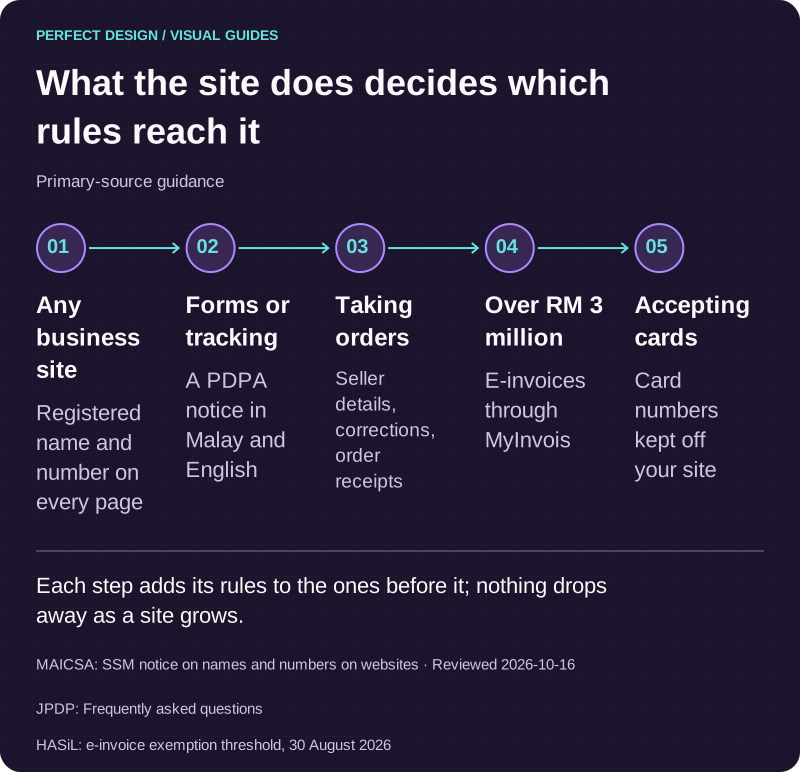
What the site does decides which rules reach it
Primary-source guidance. Each step adds its rules to the ones before it; nothing drops away as a site grows.
Source: MAICSA: SSM notice on names and numbers on websites. Reviewed .
Also: JPDP: Frequently asked questions.
Also: HASiL: e-invoice exemption threshold, 30 August 2026.
Read the graphic as text
- Any business site. Registered name and number on every page
- Forms or tracking. A PDPA notice in Malay and English
- Taking orders. Seller details, corrections, order receipts
- Over RM 3 million. E-invoices through MyInvois
- Accepting cards. Card numbers kept off your site
Your registered name and number
SSM reminded businesses in November 2023 that section 30(2)(b) of the Companies Act 2016 requires every company to display its name and registration number prominently on its website and social media, with a penalty of up to RM 50,000, three years' imprisonment or both. Businesses registered under the Registration of Businesses Act have had a similar duty since the 2020 amendment to the Business Registration Rules. The simplest way to be prominent is the footer of every page, which is where we put it.
Personal data: the notice, consent and security
JPDP's own guidance counts collecting data through a website form as processing personal data, so most business websites fall under the PDPA. Section 7 requires a written notice that tells people what is collected and why, where it came from, how to ask for access or correction, who it may be shared with, what choices they have, and whether supplying it is obligatory. The notice must be in the national language and in English.
The 2024 amendments, in force since 1 June 2025 for these duties, add two things a website owner needs to plan for. A data protection officer must be appointed and registered if you process data on more than 20,000 people, sensitive data including financial information on more than 10,000, or carry out regular and systematic monitoring, which JPDP's FAQ illustrates with online behaviour tracking. And a personal data breach must be notified to the Commissioner within 72 hours of becoming aware of it, with affected people told as well when the breach is likely to cause them significant harm.

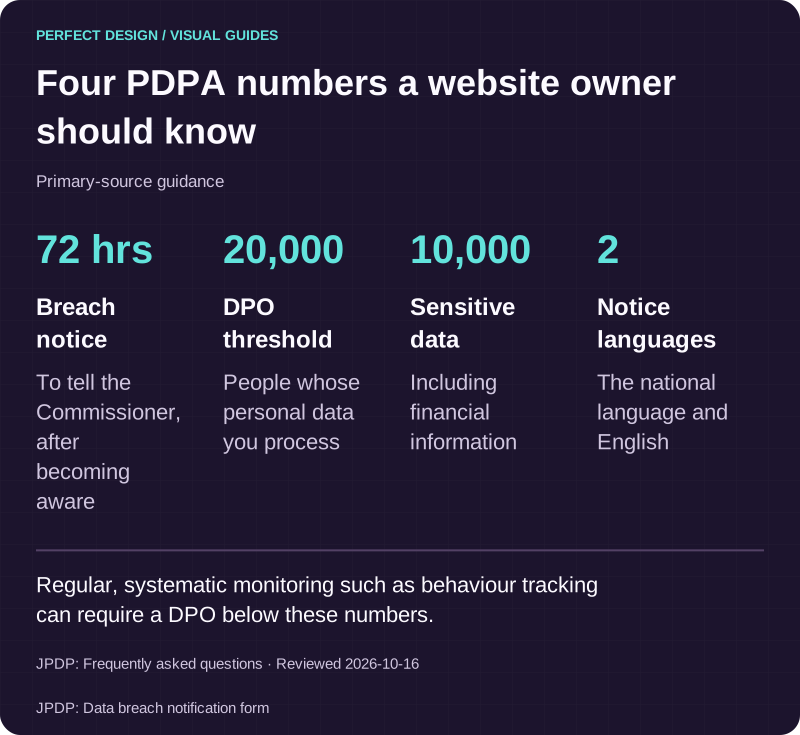
Four PDPA numbers a website owner should know
Primary-source guidance. Regular, systematic monitoring such as behaviour tracking can require a DPO below these numbers.
Source: JPDP: Frequently asked questions. Reviewed .
Also: JPDP: Data breach notification form.
Read the graphic as text
- Breach notice: 72 hrs. To tell the Commissioner, after becoming aware
- DPO threshold: 20,000. People whose personal data you process
- Sensitive data: 10,000. Including financial information
- Notice languages: 2. The national language and English
Selling online
The Consumer Protection (Electronic Trade Transaction) Regulations 2024 replaced the 2012 regulations from 25 December 2024. An online seller must show who it is and how to reach it, describe what it sells, state the full price including delivery and taxes, the payment methods, the terms and the delivery time. Buyers must be able to correct mistakes in an order, and the seller must acknowledge each order without undue delay, which in practice means an automatic confirmation by email or on screen.
The regulations also require those disclosures in Bahasa Malaysia, with other languages allowed alongside. Enforcement of the language requirement for listings was put on hold for review in June 2025, and we found no announced date for it to resume as of October 2026. Check the current position with KPDN before relying on that, and build the disclosures so a Bahasa Malaysia version can be switched on without redesigning the shop.
E-invoicing and card payments
From 1 September 2026, businesses with annual revenue below RM 3 million are not required to issue e-invoices, according to HASiL's announcement; the conditions in HASiL's FAQ decide whether your business qualifies. Above the threshold, an e-invoice is a structured file submitted to LHDN through the free MyInvois portal or its API, not a PDF. Sales made through an e-commerce platform are invoiced by the platform; your own checkout is your responsibility. More on e-invoicing from your own system.
If you accept cards, using a payment gateway reduces the work but does not remove your responsibility, as the PCI Security Standards Council puts it. The safest design keeps card numbers off your site entirely, with a hosted payment page or the gateway's own payment fields.
Cookies and accessibility
Malaysia has no rule that every website must show a cookie banner. The PDPA still applies where analytics or advertising tags process data that identifies a person, so say in your notice what you track and why. Accessibility to a WCAG level is not a general legal requirement for private businesses; the public-sector portal circular PPPA 1/2025 encourages agencies to follow WCAG, and it is worth doing anyway because it makes the site easier for everyone.
The checklist
Each item names the evidence that shows it is done. We run this list before every website and system we launch.
0 of 14 checked · saved on this device
Registered name and registration number shown prominently on the website
Evidence: The footer of every page, for example "Perfect Design (202403330300 (KT0581891-V))"
The same name and number on your social media profiles
Evidence: Each profile's about section
A privacy notice written for your own forms, systems and suppliers
Evidence: The notice lists each form and system, the purposes and the classes of third parties
The notice published in Bahasa Malaysia and English
Evidence: Both versions live and linked from every form
Consent recorded where a purpose needs it, such as marketing
Evidence: Each record stores the choice, the time and the notice version; no pre-ticked boxes
A way to request access to or correction of personal data
Evidence: A named contact and address in the notice
Only the data you need, kept only as long as you need it
Evidence: A list of fields per form and a deletion schedule
A decision on whether you need a data protection officer
Evidence: A note of your volumes and tracking against the JPDP thresholds; the DPO registered if any apply
A breach procedure and a named person
Evidence: Who assesses a breach, and how the Commissioner is told within 72 hours of becoming aware
Online shops: seller details, full prices, payment methods, terms and delivery times
Evidence: Shown before the order is placed; a Bahasa Malaysia version ready
Online shops: buyers can correct an order, and every order is acknowledged
Evidence: An editable cart and review step, and an automatic confirmation
E-invoicing checked against the RM 3 million threshold
Evidence: Your revenue position recorded; MyInvois set up if you are above it
Card numbers never stored or handled by your site
Evidence: A hosted payment page or the gateway's own payment fields
Tracking described in the privacy notice
Evidence: The analytics and advertising tags listed with their purpose
Does a website without a form need a privacy notice?
If it collects no personal data at all, with no forms, no accounts and no tracking that identifies people, the PDPA notice duty may not be triggered. The SSM display rule still applies. Most business sites have at least an enquiry form or a chat button that collects details, so most need a notice.
Do I need a cookie banner in Malaysia?
There is no Malaysian rule that requires one. If your tags process data that identifies people, the PDPA applies, so describe them in your notice and get consent where a purpose needs it.
Is this legal advice?
No. It explains published rules as they stood on 16 October 2026 and what they usually mean for a website. For a decision about your own business, ask a lawyer or the regulator.
Where to go next
- Corporate and government projects →
The PDPA pack, accessibility report and other delivery terms we write into corporate agreements.
- E-invoicing (MyInvois) integration →
When your system has to issue e-invoices, and how they reach LHDN.
- Online signing and consent →
Consent records, sign-off and document uploads built into forms and portals.
- Online payments →
Checkouts built on hosted payment pages, so card numbers never touch your site.
Rather have this handled?
Talk to us about business & corporate websites for your business, starting with the questions this guide helped you identify.
Sources and further reading
- MAICSA: SSM notice on displaying the registered company or business name and number on websites (1 November 2023) — read 16 October 2026
- JPDP (Personal Data Protection Department): Frequently asked questions — read 16 October 2026
- JPDP: Data breach notification form (March 2025) — read 16 October 2026
- Personal Data Protection Act 2010 (Act 709), section 7, as reproduced by Low & Partners — read 16 October 2026
- JPDP: Commencement of the Personal Data Protection (Amendment) Act 2024 — read 16 October 2026
- HASiL media statement: e-invoice exemption threshold raised to RM 3 million (30 August 2026) — read 16 October 2026
- HASiL: e-Invoice general FAQs (updated 4 September 2026) — read 16 October 2026
- Consumer Protection (Electronic Trade Transaction) Regulations 2024, P.U.(A) 449/2024 (KPDN repository) — read 16 October 2026
- PCI Security Standards Council FAQ 1092: using a third-party service provider — read 16 October 2026
- Chambers and Partners practice guide: Data Protection and Privacy, Malaysia (cookies and tracking) — read 16 October 2026