

On this page
Interruption, not intent
Start with the difference that decides everything else. On Google somebody has typed a need and you are answering it. On Facebook and Instagram nobody typed anything: they are catching up with people they know, and your advert lands between two things they chose to look at. So the advert has to create the interest that a search advert merely captures.
That cuts both ways, which is why the two channels are not substitutes. Meta reaches people before they are in the market, introduces things nobody would think to search for, and shows a product visually instead of waiting for someone to describe it in words. It just makes you carry the whole burden of interest yourself — which is why a search advert pasted into a feed usually does nothing at all.
Three levels, and which decision lives where
Meta's developer documentation is precise about the hierarchy, and knowing it ends most confused conversations about "the campaign". A campaign "is the highest-level organizational structure within an ad account and should represent a single objective". The ad set is where "the budget, billing, and duration are set... and apply to all ads in the set", along with the audience and the optimisation goal. The ad carries the creative.
| Level | What is set there | Why it matters to you |
|---|---|---|
| Campaign | One objective for everything beneath it | Changing it changes what the system optimises toward — it is a machine instruction, not a label |
| Ad set | Budget, schedule, bidding, audience, optimisation event | Where spend is controlled and where an audience comparison is either set up properly or ruined |
| Ad | The image or video, the copy, the destination | Where most testing should happen, and the part most often left untouched for months |
How the auction picks a winner
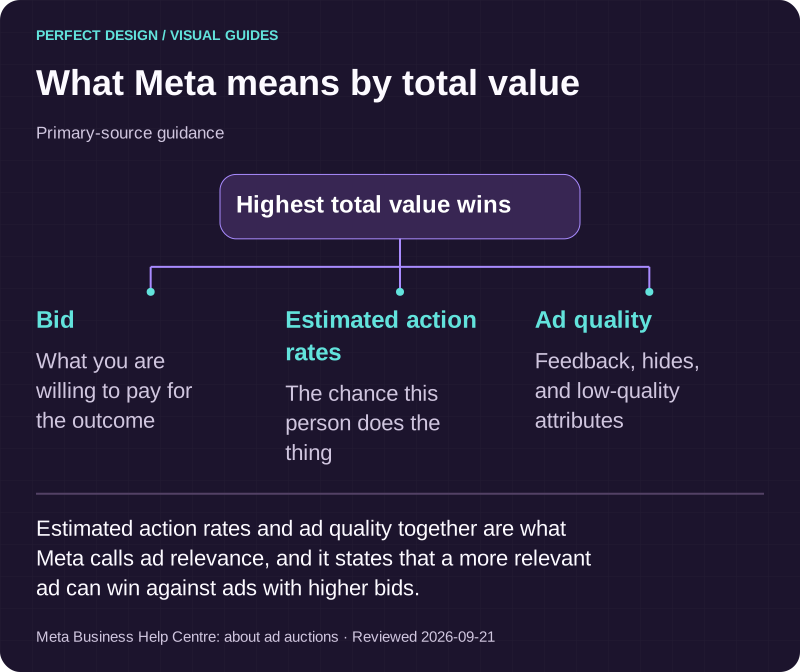
An auction runs "each time there's an opportunity to show an ad to someone" — Meta says billions take place every day. The winner is "the ad with the highest total value, subject to a price floor", and total value "is a combination of three major factors": the bid you placed, estimated action rates (the probability that showing this advert to this person produces the outcome you asked for), and ad quality (measured from sources including whether people hide the advert, and low-quality attributes such as withholding information, sensationalised language and engagement bait).

What Meta means by total value
Primary-source guidance. Estimated action rates and ad quality together are what Meta calls ad relevance, and it states that a more relevant ad can win against ads with higher bids.
Source: Meta Business Help Centre: about ad auctions. Reviewed .
Read the graphic as text
Highest total value wins
- Bid. What you are willing to pay for the outcome
- Estimated action rates. The chance this person does the thing
- Ad quality. Feedback, hides, and low-quality attributes
The learning phase, and the cost of tinkering
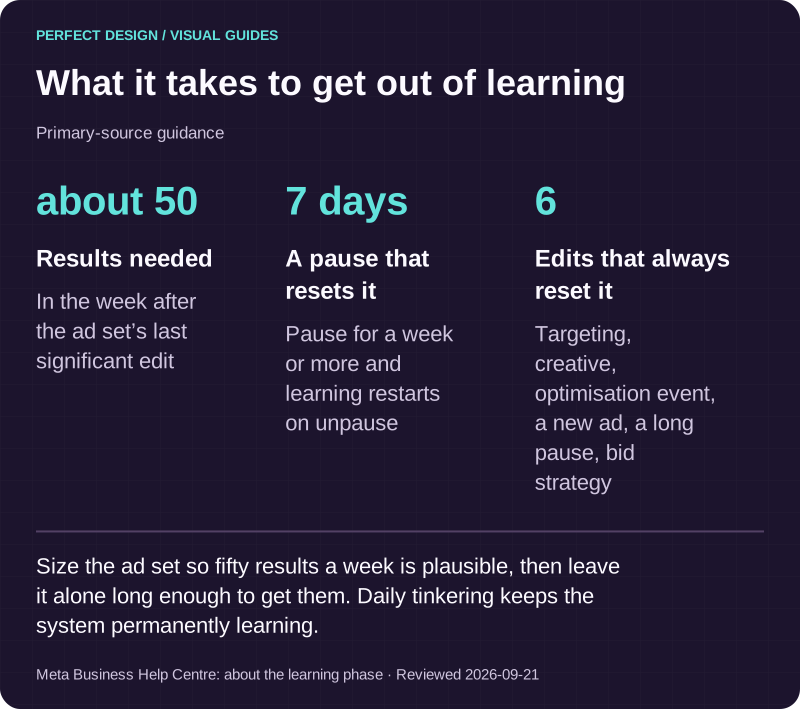
A new or significantly edited ad set enters a learning phase, which Meta describes as "the period when the delivery system still needs to learn about how an ad set may deliver and perform". Ad sets leave it "as soon as they can deliver stably", and Meta says this "usually occurs after about 50 results in the week after the ad set's last significant edit". While in it, performance is less stable and the cost per result is usually higher. If there are never enough results, the status reads "Learning limited".
This is where impatience becomes expensive, because Meta publishes exactly which edits restart the clock. These are always significant:
- Any change to targeting.
- Any change to ad creative.
- Any change to the optimisation event.
- Adding a new ad to the ad set.
- Pausing the ad set for seven days or longer — it re-enters learning when you unpause it.
- Changing the bid strategy.
Budget changes, spending limits and cost or ROAS goals "may or may not be significant, depending on the magnitude of the change" — Meta's own example is that moving a budget from $100 to $101 is unlikely to reset anything, while $100 to $1,000 may. Two practical rules follow. Set a budget that can produce roughly fifty of your chosen result in a week, or pick a cheaper result to optimise for. And decide changes on a schedule rather than on a mood, because a daily nudge means the system is permanently learning and never delivering.

What it takes to get out of learning
Primary-source guidance. Size the ad set so fifty results a week is plausible, then leave it alone long enough to get them. Daily tinkering keeps the system permanently learning.
Source: Meta Business Help Centre: about the learning phase. Reviewed .
Read the graphic as text
- Results needed: about 50. In the week after the ad set’s last significant edit
- A pause that resets it: 7 days. Pause for a week or more and learning restarts on unpause
- Edits that always reset it: 6. Targeting, creative, optimisation event, a new ad, a long pause, bid strategy
The creative is the variable
Targeting decides who is eligible; the creative decides whether anyone stops. Since the auction rewards estimated action rates and ad quality, the advert is not decoration on top of the media buy — it is a direct input into what you pay. That makes producing genuinely different ideas the real work, rather than producing one advert and adjusting the button.
Different has to mean different: a different opening moment, a different claim, a different format, a different person on screen, a different problem named first. Three variations of one idea teach you nothing, because when they perform alike you still do not know which idea was wrong. And because every creative change is a significant edit, creative testing has to be planned as a cycle with room to settle, not as a series of interruptions.
- Write for sound off. Assume the video is muted and the first frame is all you get.
- Say the thing first. The offer or the problem belongs in the opening moment, not after a branded title card.
- One idea per advert. An advert making three arguments makes none of them well and cannot be interpreted afterwards.
- Build for vertical. Stories and Reels are full-screen vertical; a cropped landscape video looks like it was made for somewhere else, because it was.
- Plan for fatigue. Creative wears out against the same audience, so replacement is scheduled work, not an emergency.
Measurement: two pipes, one event
The Meta Pixel is JavaScript in a visitor's browser, so anything that interferes with a browser interferes with it: a blocker, a privacy setting, a bad connection, somebody leaving before the page finishes. The Conversions API is the server-side route, connecting your server, website platform or CRM to Meta directly, and Meta processes those server events in a similar way to Pixel events.
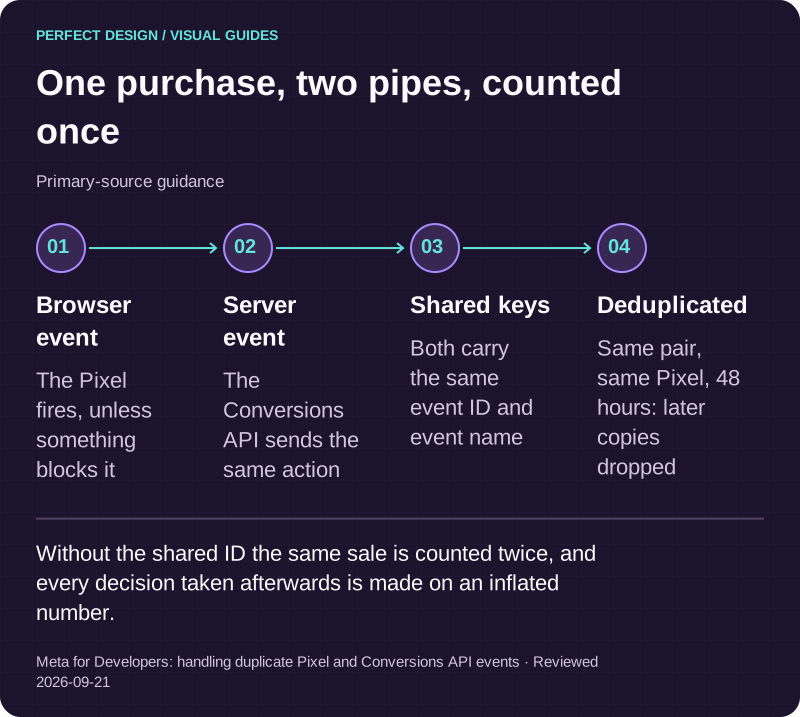
Run both and the same purchase can arrive twice, so the two have to be tied together. Meta's documentation is specific: events are matched on their ID and name — the Pixel's eventID must match the Conversions API's event_id, and the Pixel's event must match event_name. When the same combination reaches the same Pixel ID within 48 hours, "we discard the subsequent events". If nobody sets that up, your reporting quietly double-counts, and every decision downstream is made on inflated numbers.
In Malaysia there is usually a third pipe nobody instrumented. The advert sends the person into WhatsApp, and the conversation that decides the sale happens in a phone. Meta can record that somebody started a chat; only your team can record whether it became a customer. Without a record on that side from day one, the campaign gets judged on the cheapest thing it produced rather than on the thing you wanted.

One purchase, two pipes, counted once
Primary-source guidance. Without the shared ID the same sale is counted twice, and every decision taken afterwards is made on an inflated number.
Source: Meta for Developers: handling duplicate Pixel and Conversions API events. Reviewed .
Read the graphic as text
- Browser event. The Pixel fires, unless something blocks it
- Server event. The Conversions API sends the same action
- Shared keys. Both carry the same event ID and event name
- Deduplicated. Same pair, same Pixel, 48 hours: later copies dropped
Attribution is a setting, not a fact
A great deal of argument about results is really an argument about attribution settings that nobody read. Meta lets you choose an attribution model at the ad set level — standard, incremental or custom — and for standard attribution it lets you choose which actions earn credit and over what period: click-through counts events within 1 day or 7 days of a link click, view-through counts events within 1 day of an impression, and engage-through counts events within 1 day of a non-link click, including a video played for 5 seconds.
Two consequences are worth carrying into every report. A longer window will always show more conversions than a shorter one, so "results went up" can simply mean the setting changed. And Meta warns that results cannot be compared across ad sets using different attribution models, because each uses a different counting mechanism. Write down which setting your reporting uses, and keep it still.
Who owns the account
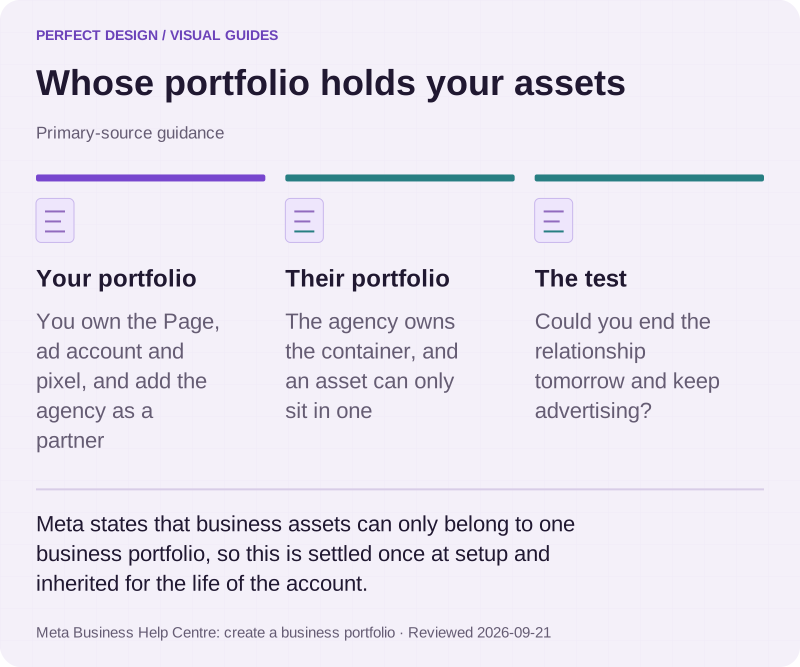
This is the part businesses most often get wrong, and it is the most expensive to fix. A business portfolio is the container that holds your organisation's assets — Facebook Pages, Instagram accounts, ad accounts, apps and pixels. Meta's rule is blunt: "Business assets can only belong to 1 business portfolio." So whoever's portfolio holds the ad account, the Page and the pixel controls them, and an asset cannot simply be moved to another one.
The right arrangement is therefore the one Meta documents for agencies: your business creates and owns the portfolio, and you "add partners, such as people who work at an agency your organization works with". The agency gets access; you keep the asset and the history. If an agency built your account inside their own portfolio, the advertising history, the pixel data and the audiences built from it sit on their side of the line — which is a question worth asking at the proposal stage rather than at the end of a relationship.

Whose portfolio holds your assets
Primary-source guidance. Meta states that business assets can only belong to one business portfolio, so this is settled once at setup and inherited for the life of the account.
Source: Meta Business Help Centre: create a business portfolio. Reviewed .
Read the graphic as text
- Your portfolio. You own the Page, ad account and pixel, and add the agency as a partner
- Their portfolio. The agency owns the container, and an asset can only sit in one
- The test. Could you end the relationship tomorrow and keep advertising?
What to do next
Three checks, in this order. Ownership: open your business portfolio and confirm the ad account, Page and pixel sit inside a portfolio your business created. Measurement: confirm that what you actually care about — an enquiry, a booking, a sale — is a defined event, that Pixel and Conversions API events share an ID, and that you know which attribution setting the report uses. Patience: check the last significant edit date on your ad sets, and whether the budget is realistically capable of producing around fifty results a week.
If you are about to build a campaign, Choosing a Meta Ads objective covers the four settings that decide what the system chases. The paid-search counterpart, where people are already searching for what you sell, is How Google Ads works. What a managed engagement covers on Meta specifically is on Meta Ads management.
Where to go next
- Choosing a Meta Ads objective →
The first two minutes of building a campaign, where most of the money is decided.
- Meta Ads management →
What an engagement covers, and what to agree before any budget is committed.
- How Google Ads works →
The other half of paid media: people who are already searching for what you sell.
- Landing page design →
Where the click lands, which decides whether any of the above turns into an enquiry.
- WhatsApp automation →
Most Malaysian Meta campaigns end in a WhatsApp chat, and that hand-off is where enquiries are lost.
Sources and further reading
- Meta Business Help Centre: About ad auctions — read 21 September 2026
- Meta Business Help Centre: About the learning phase — read 21 September 2026
- Meta Business Help Centre: Significant edits and learning phase — read 21 September 2026
- Meta Business Help Centre: About attribution models and attribution settings — read 21 September 2026
- Meta Business Help Centre: Create a business portfolio — read 21 September 2026
- Meta for Developers: Campaign structure — read 21 September 2026
- Meta for Developers: Conversions API — read 21 September 2026
- Meta for Developers: Handling duplicate Pixel and Conversions API events — read 21 September 2026
- Meta for Developers: Aggregated Event Measurement — read 21 September 2026