
iCAUR Singapore
Bringing a new automotive brand to Singapore: a premium website, a Content Studio the client controls, connected lead capture and an AI experience that lets visitors imagine their own V23.
- Client
- Vertex Automobile Pte Ltd
- Brand & market
- iCAUR · Singapore
- Engagement
- July–September 2026
- Our role
- Web implementation, CMS, integrations & launch
The brief
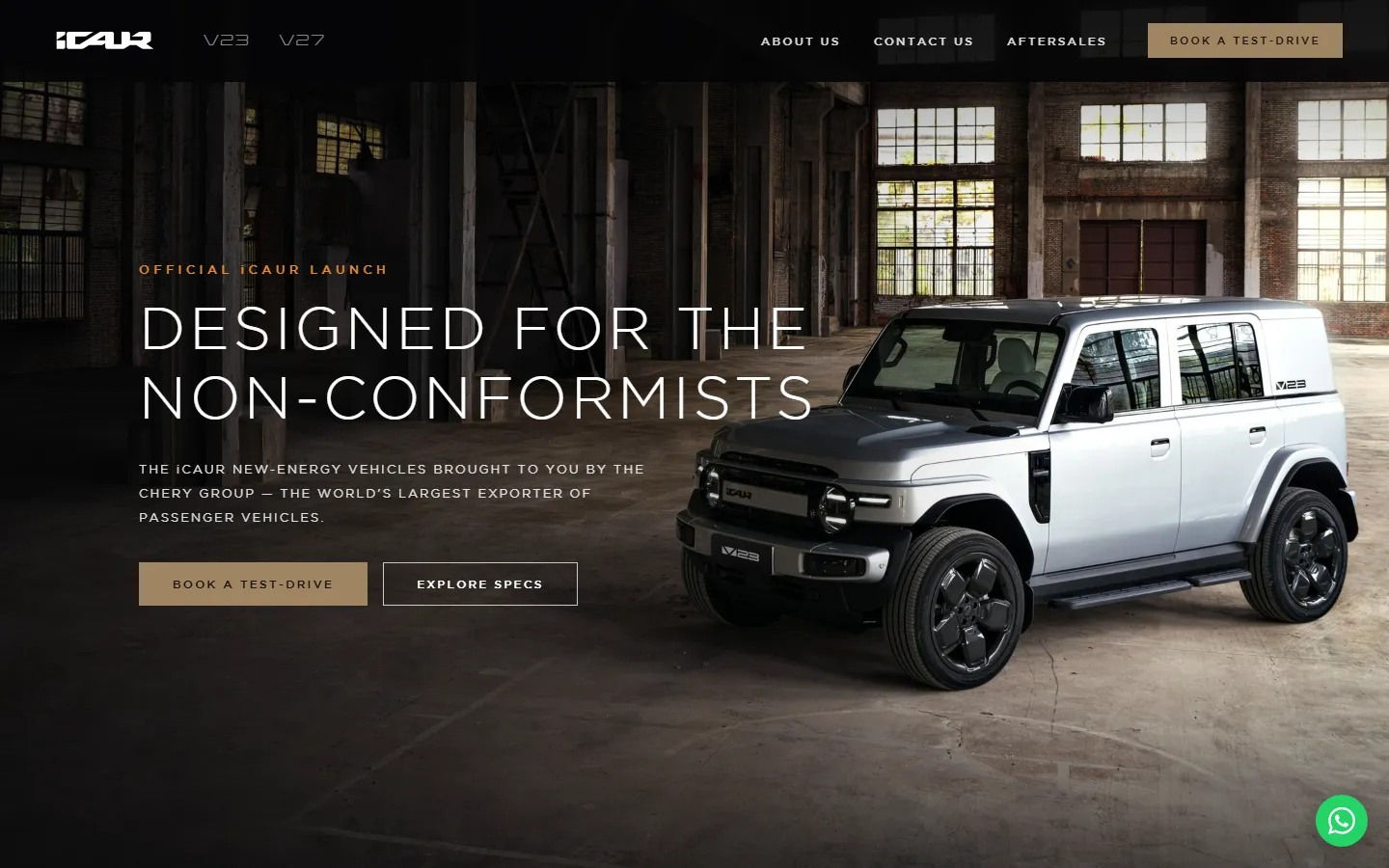
Vertex Automobile, the Singapore distributor for iCAUR, Chery Group’s new-energy vehicle brand, needed a website for the V23 launch. It had to carry the presence of an international automotive brand, make it easy to explore the vehicle and enquire, and give the local marketing team control of its content. Every lead needed to reach the tools the team already used.
What we shipped
A responsive brand and model website, a purpose-built Content Studio, Google Sheets lead integration and the “Imagine your iCAUR” AI image studio. We also built an aftersales booking extension, ready for activation when the client’s scheduling account is connected. The production website went live on 18 September 2026.
Built for: Vertex Automobile Pte Ltd — serving prospective drivers, the Singapore marketing team and the sales team.
01 · The customer experience
A distinctive vehicle deserves a considered digital introduction.
The V23 has a recognisable silhouette and a strong visual identity. The website needed to give that identity room: large vehicle imagery, confident typography, film and clear routes into the model. The client’s design agency supplied the mockups and brand direction; Perfect Design translated them into a responsive, working experience, refining layout, motion and interaction against the supplied artwork.
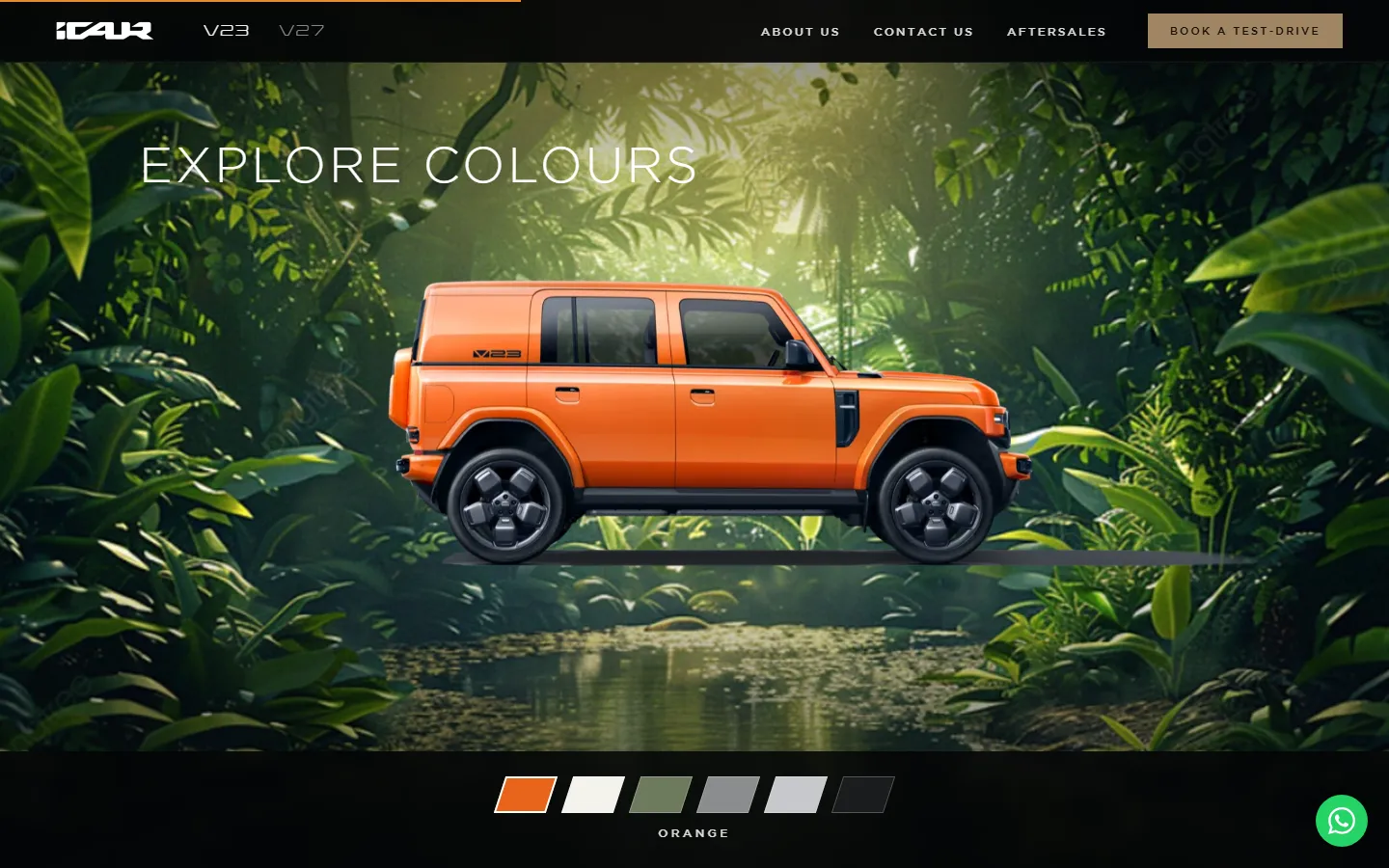
On the model page, visitors move from the vehicle’s character into the details that matter to a purchase decision. The colour explorer pairs each of seven official finishes with a matching vehicle cut-out and background scene. Feature sliders introduce the design and equipment, specifications offer a closer comparison, and test-drive calls to action keep the next step within reach.
Mobile received its own compositions based on the agency’s vertical artboards. Hover interactions became tappable or gently cycling sequences, sliders support touch and keyboard browsing, and motion pauses when it is off-screen or the visitor prefers reduced movement. Brand films and imagery remain editable by the client, so a campaign can change without rebuilding the page.
02 · The client’s workspace
Freedom to change the content. Confidence in the design.
The most important CMS requirement was also a boundary: the marketing team should be able to update the website, but should never need to rebuild a layout. A general page builder would have handed over spacing, typography and composition along with the words. We built the Content Studio around the approved design instead.
Each page is defined as sections and editable fields. The dashboard exposes those fields and stores only the client’s changes; resetting a field restores the original approved content. The delivered schema covers 10 dashboard pages, 40 sections and 100 editable fields, plus a separate vehicle-model template with 11 sections and 25 fields.¹ Text, banners, films, specifications, showroom details and contact information have a clear home.
Vehicle pages are instances of that shared template. The team can add a model with a coherent page structure, then fill in the differences. News has a draft-and-publish workflow. The shared media library supports images, video and downloadable PDFs, shows where files are used and prevents removal of media still in use. Section and menu switches let the team time a release without waiting for a deployment.
¹ CMS coverage at handover. Vehicle-template fields are counted separately from the 100 page fields.
Approved structure
The design defines the page, sections and permitted fields.
Client edits
Marketing updates content and media in the Content Studio.
Publish & refresh
Affected pages refresh while the layout stays consistent.
03 · From interest to follow-up
An enquiry should arrive where the sales team already works.
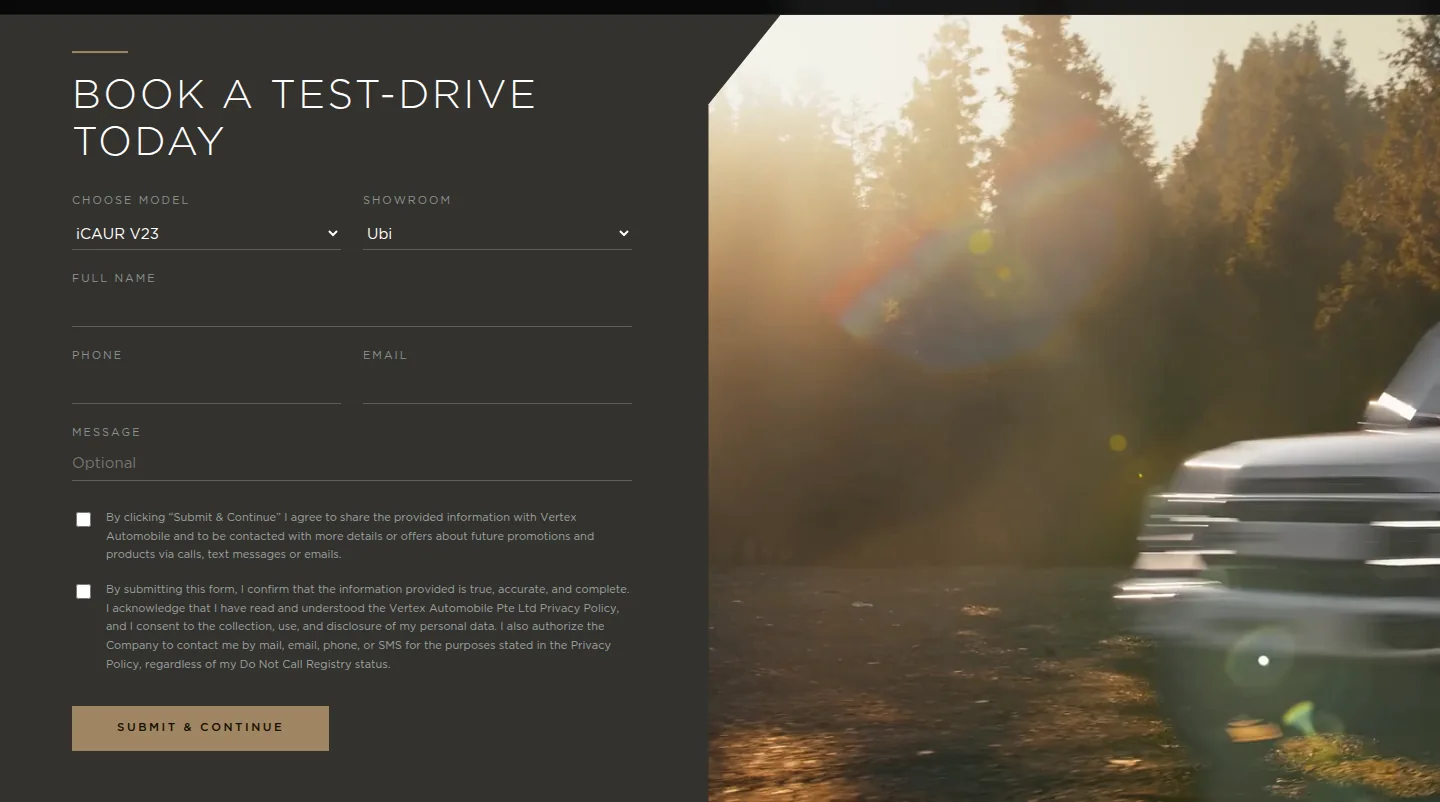
A polished form is only the first half of lead capture. The original brief required each enquiry to reach a spreadsheet owned by the client. The test-drive form collects the selected vehicle and showroom alongside contact details and the two PDPA consent choices specified by the client’s legal team. Server-side validation, a honeypot and a human check protect the submission path.
Website enquiries, newsletter subscriptions and AI-studio registrations each sync into their own Google Sheets tab. A record is marked as synced only after Google accepts it, leaving failed pushes available for retry; the dashboard also offers a manual sync. Phone numbers are stored as literal text so international prefixes survive the handoff. Email notifications give sales a reply-to address for the customer, and the client’s existing respond.io workspace provides live chat.
The result is a connected workflow the team can operate: review the enquiry, follow up from its existing tools and export records when needed.
Explore & enquire
The visitor chooses a model and showroom and gives consent.
Validate & save
The platform checks the submission and records the enquiry.
Sync & notify
The client’s spreadsheet and email receive the lead for follow-up.
04 · An experience beyond the brochure
Imagine your iCAUR. Keep it recognisably an iCAUR.
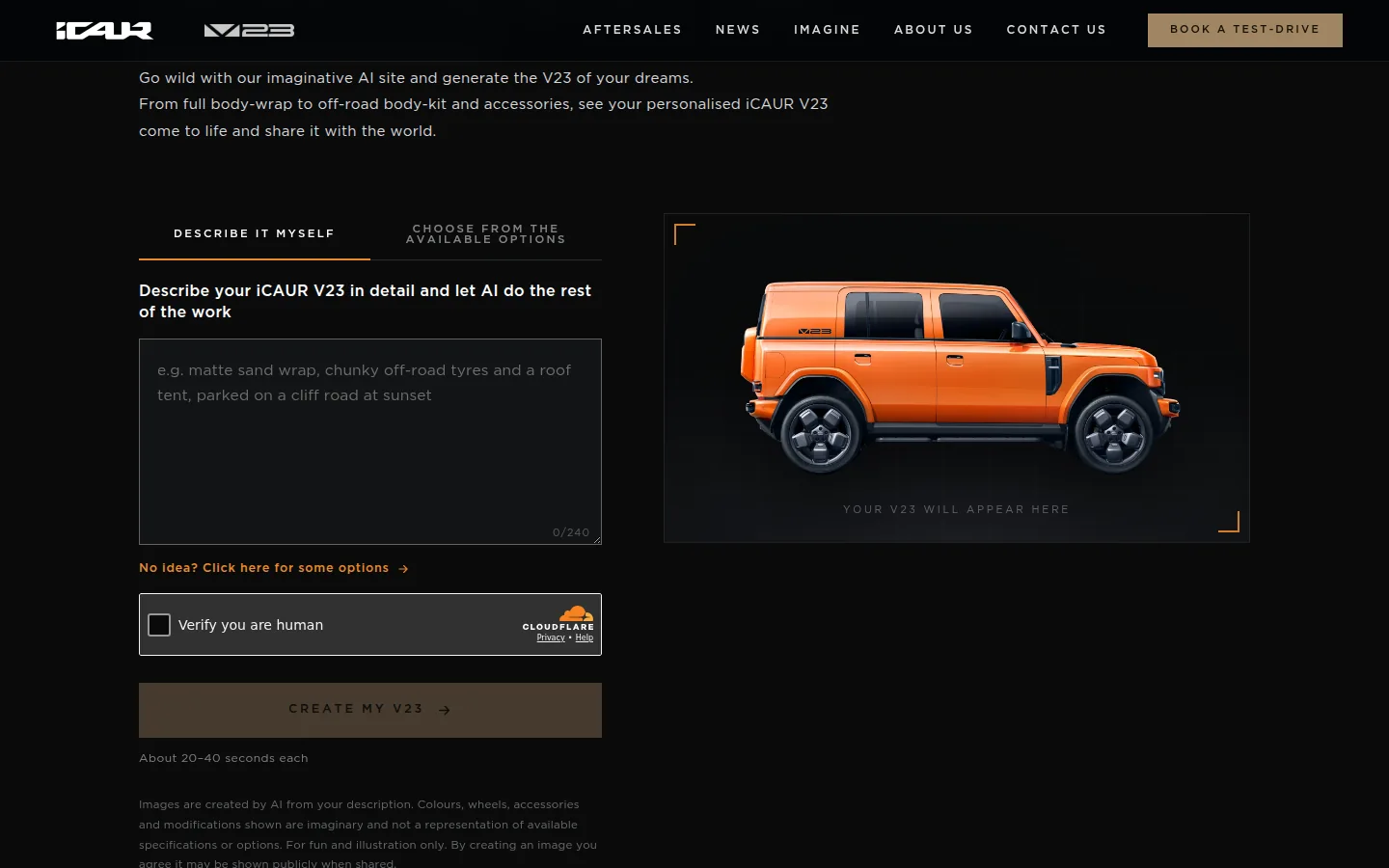
During the engagement, the client added an AI image studio: visitors could describe a wrap or scene, create their own V23 image and share it. It brought together a playful brand experience, a registration journey and content the visitor could take away. People can start with their own words or choose from the client’s preset styling groups.
The difficult part was product identity. A prompt alone could produce a convincing SUV that was not the V23. Even one side-profile reference left the model guessing at the front. We tested candidate models against the same briefs and introduced four official reference images: the selected colour’s side profile, two front views and a rear-lamp detail. The references gave the system visual evidence of the actual vehicle.
When the client narrowed the output to side profiles, the workflow gained a separate image check. A result with the wrong angle is retried once; if it still misses, the visitor gets an explanation without losing their allowance. Registration, human checks, content screening, per-person limits and a monthly budget sit around the generation step. Budget accounting follows model calls, including retries.
Finished images have share pages and social previews, with a community wall and moderation in the client dashboard. Hiding a creation also withdraws its image and share link. A touchscreen kiosk variant was built on the same pipeline, with larger controls, an on-screen keyboard and a QR handoff for the guest’s image. The team can enable this mode for touchscreen events.
05 · Extending the platform
One workshop schedule across two brand websites.
The aftersales request arrived later: a service-booking experience whose appointment capacity would be shared with a sister brand’s WordPress site. Two separate calendars could offer the same workshop capacity twice. The extension therefore uses one availability feed and an embeddable booking widget, with presentation that can match each brand.
Calendly provides the scheduling foundation, with custom rules for the workshop: three working days’ notice, Saturdays counted as working days, Sundays and public holidays excluded, and shared weekday capacity limits. The client can maintain closure dates. Booking and cancellation events are recorded once even if a webhook is redelivered, and staff have search, status filters and exports.
This extension was built and tested with synthetic bookings, then deployed behind configuration. At the time of this case study, activation still requires the client’s scheduling account; the sister-brand installation also requires WordPress access. It is delivered capability awaiting activation, rather than a live appointment service.
Status at 22 September 2026: built and tested; awaiting client activation.
06 · Working with real constraints
Launching across teams, regions and domain ownership.
The local distributor owned the website brief, while headquarters retained control of the domain and would not delegate its nameservers. That changed the launch path. We prepared exact bilingual DNS requests in the headquarters team’s own format and connected the www hostname through Cloudflare for SaaS, preserving their control of the domain.
The root domain needed a separate redirect arrangement. It now takes visitors to the canonical www address while preserving the path and query. The website became available on www.icaur.com.sg on 18 September; the root-domain redirect followed on 22 September. Email authentication was handled without changing the client’s existing mailbox setup.
Review access mattered too. Headquarters reviewers in mainland China could not reliably use the standard Cloudflare development and storage hostnames, so we provided a review mirror on a reachable domain. Content refreshes included that mirror. A feedback cycle only works when everyone can open the current version.
07 · The work behind the experience
Fast delivery, reliable updates and a platform the client can keep running.
The website runs on Next.js and Cloudflare Workers, with D1 for changing data and R2 for media. Public brand pages usually change only when an editor publishes something. We therefore render them once, serve them from cache and refresh the affected pages after a dashboard save. Background warming prepares the next version before visitors need it.
During development, the project recorded roughly 46 ms of Worker CPU for rendering a page on every request, compared with around 4 ms median for cached delivery. That is a server-compute measurement, not a visitor page-load time or a promise about every request. The distinction shaped an architecture that could run within the initial hosting budget; the project moved to a paid plan as the AI studio expanded.
Large video files use storage delivery with byte-range support, including the behaviour Safari needs. AI images have web-sized versions and small thumbnails for the community wall. External calls have timeouts and retry handling; region-sensitive image requests use a relay in a supported region. These choices address the parts of the experience that can otherwise fail after a successful build.
The handover includes deployment and integration runbooks, dashboard guidance, cache-refresh tooling and booking-rule checks. Dashboard access, input validation, media moderation and security headers were part of the launch work. Search foundations include canonical URLs, a sitemap, page metadata and structured data for the business, vehicle and news content. Marketing can maintain those fields alongside the pages they describe.
From brief to production · 2026
The delivery, and what it leaves the team with.
2 July
The engagement begins
Signed brief for the website, editable dashboard and Google Sheets lead integration.
July
Design becomes a working platform
Content Studio, first review draft, vehicle template and responsive implementation of the supplied mockups.
August
The connected experiences take shape
Lead integrations, aftersales extension and AI studio, with vehicle-reference and sharing work.
18 September
The production domain goes live
www.icaur.com.sg launches through the headquarters-controlled DNS arrangement.
22 September
Launch foundations completed
Root-domain redirect, email verification and search setup, alongside operational handover.
A coherent introduction to the brand
The Singapore website connects brand storytelling, the V23 model, specifications and enquiries in a responsive experience built from the approved creative direction.
Control for the local team
Marketing can update content, models, news, media and launch switches without changing the design. Sales can work with leads in its own spreadsheet and email tools.
Room to extend the relationship
The AI studio adds a creative reason to engage with the brand. The prepared aftersales extension gives the platform a path beyond the initial vehicle launch.
Delivery status at 22 September 2026: the brand website, Content Studio, lead integrations and AI studio are delivered. Aftersales scheduling awaits client activation.
For your next project
Explore the services behind this work.
A brand website with a clear customer journey and content your team can maintain.
See how a structured CMS protects design while giving editors control.
Connect the enquiry on the website to the next step inside your business.
Core systems
What this build is made of
These are systems we build repeatedly — each links to every other project that contains it, so you can compare implementations before deciding what you need.
Unique to this build
Built specifically for this project rather than assembled from the shelf.
V23 colour explorer
Seven official finishes, each pairing the vehicle cut-out with its matching scene.
Imagine your iCAUR
An AI image experience with vehicle references, side-profile checks, sharing and client moderation.
Shared aftersales scheduling
A booking extension built for two brand websites, with working-day notice and workshop capacity rules. Awaiting client activation.
Want something built to this standard?
Tell us what you have in mind and we'll put together a functional prototype of your project — free.