

On this page
Three campaign types, three different jobs
Google's own descriptions are the cleanest starting point. Search campaigns are "text ads on search results that let you reach people while they're searching on Google". Shopping ads are "product listings that are ideal if you're a retailer looking to sell your product inventory", and they "display a product photo, title, price, store name, and more". Performance Max is "a goal-based campaign type that allows you to access all Google Ads inventory" from a single campaign — YouTube, Display, Search, Discover, Gmail and Maps.
The sentence that matters most for a retailer is this one: Shopping ads "use your existing Merchant Center product data (not keywords) to decide how and where to show your ads". A Shopping campaign has no keyword list to write. What it shows, and what it is eligible for, comes out of your product feed — so the feed is not an input to the campaign, it largely is the campaign.
| Search | Shopping | Performance Max | |
|---|---|---|---|
| Built from | Keywords and written ads | Merchant Center product data | Assets, conversion goals and audience signals |
| Where it appears | Google search results | Shopping tab, Search, Images and Search Partner sites | All Google inventory in one campaign |
| What the person sees | Text answering their words | Photo, title, price and store name | Whatever surface they were on |
| Reporting grain | Search terms, keywords, ads | Products and product groups | Assets and channels, with less detail per placement |
What each one needs before it can run
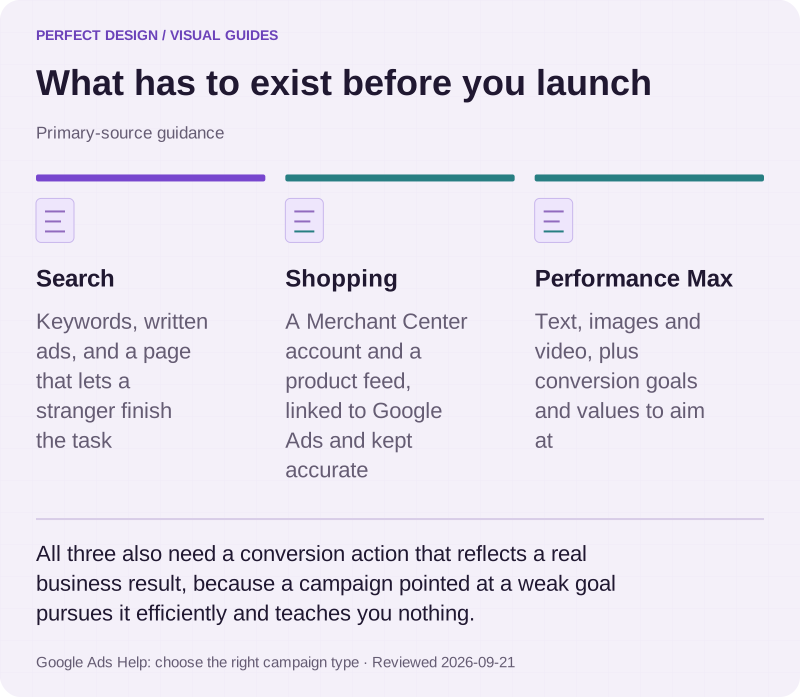
Most of the disappointment with campaign types comes from launching one whose prerequisites were not in place. Search needs a keyword list, written adverts, and a page that lets a stranger finish the task. Shopping needs a Google Merchant Center account with a product data feed, linked to Google Ads, with product data that is accurate and stays accurate. Performance Max needs assets — text, images and videos — plus conversion goals and values, and optionally audience signals used to guide its learning.
All three need one thing in common that has nothing to do with Google: conversion measurement that reflects a real business result. Google defines a conversion action as "a specific customer activity that is valuable to your business", and you choose which activities count. Performance Max in particular optimises toward the goals you declare, so a campaign pointed at a weak goal will pursue it efficiently and teach you nothing.

What has to exist before you launch
Primary-source guidance. All three also need a conversion action that reflects a real business result, because a campaign pointed at a weak goal pursues it efficiently and teaches you nothing.
Source: Google Ads Help: choose the right campaign type. Reviewed .
Read the graphic as text
- Search. Keywords, written ads, and a page that lets a stranger finish the task
- Shopping. A Merchant Center account and a product feed, linked to Google Ads and kept accurate
- Performance Max. Text, images and video, plus conversion goals and values to aim at
Where control sits, and what you give up
Control is the real axis these three differ on. In Search you can see the search terms that triggered your advert, exclude the ones you never want, and write the words the person reads. In Shopping you control the product data and how products are grouped, but not a keyword list. In Performance Max you set goals and supply assets, and the system decides the rest across every surface.
Google is explicit that the responsibility does not transfer with the control: advertisers "remain responsible for reviewing and ensuring compliance and accuracy of landing page content, and all dynamically generated assets". Automation moves the work, not the accountability. That is the trade to weigh — less steering in exchange for reach, with the same obligation to check what is being said in your name.
When they compete with each other
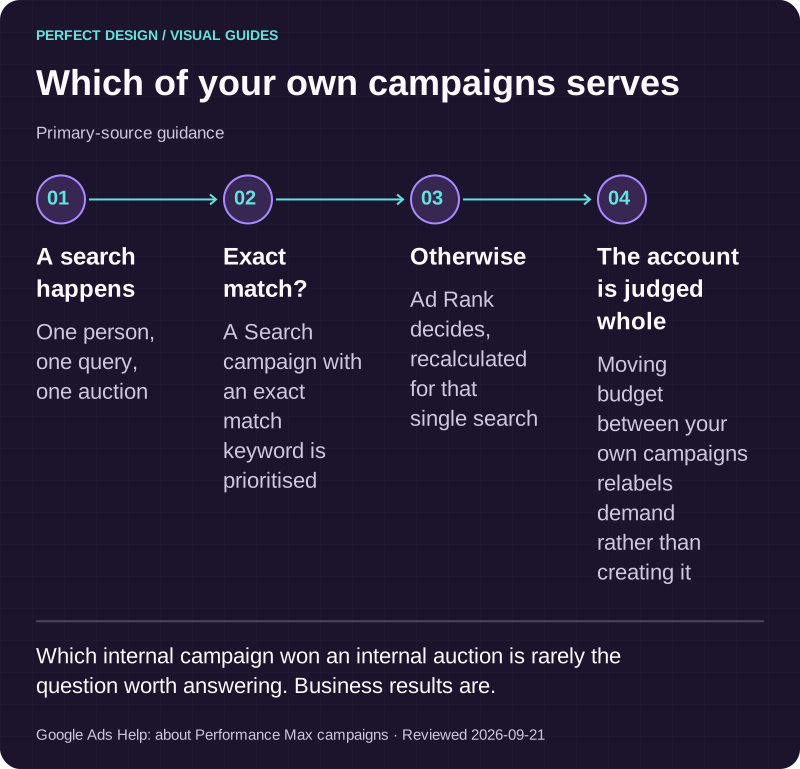
Run more than one of these and they will meet in the same auction, so it is worth knowing the published rule: "Search campaigns containing an exact match keyword are prioritized to serve over Performance Max". Everything else is decided the usual way — Ad Rank is recalculated for every single search, from your bid, the quality of the ad and landing page, the thresholds, the competition, the context of the search and the expected impact of your assets.
The practical consequence is that "which campaign got the credit" is often the wrong question. If the same customer could have been reached by two of your own campaigns, moving budget between them does not create demand — it relabels it. Keep the account structured so that each campaign has a job you could describe in a sentence, and judge the account as a whole against business results rather than against which internal campaign won an internal auction.

Which of your own campaigns serves
Primary-source guidance. Which internal campaign won an internal auction is rarely the question worth answering. Business results are.
Source: Google Ads Help: about Performance Max campaigns. Reviewed .
Read the graphic as text
- A search happens. One person, one query, one auction
- Exact match?. A Search campaign with an exact match keyword is prioritised
- Otherwise. Ad Rank decides, recalculated for that single search
- The account is judged whole. Moving budget between your own campaigns relabels demand rather than creating it
How to choose, honestly
Four questions settle this faster than any comparison table, and three of them are about your business rather than about Google.
- Is your product data reliable enough to advertise from? If titles, prices and availability are not correct today, a Shopping or Performance Max campaign will publish the errors at scale.
- How much query control do you actually need? Regulated categories, narrow professional services and anything with easily confused search terms usually need Search, where terms can be read and excluded.
- Can you tell product demand from broad reach in your reporting? If every result lands in one undifferentiated number, a campaign that spans six surfaces will be unreadable.
- Do the margins and the stock support it? A campaign that sells items you cannot fulfil, or sells them below contribution, is a fast way to lose money accurately.
One Malaysian wrinkle is worth naming. If most of your selling happens through a marketplace or a chat, the store your feed points at may not be where your stock truth lives. A feed that advertises what you cannot actually ship costs more than the clicks: it produces refunds, complaints and disapprovals, and it takes the campaign down with it.
What no campaign type can do
None of these creates demand that does not exist. Search finds people already looking, Shopping puts your products in front of people comparing similar ones, and Performance Max looks for the people most likely to do the thing you asked for across more surfaces. Automation changes how that search is conducted; it does not add buyers to the market.
So the decisions that move the result are usually upstream of the campaign type: what you sell, at what price, with what proof, and what happens to an enquiry after it arrives. The mechanics underneath every campaign type — the auction, budgets, conversion counting and policy — are explained in How Google Ads works. The Search campaign type in depth, including matching and exclusions, sits on Google Search Ads.
Where to go next
- How Google Ads works →
The machinery underneath all three: the auction, budgets, conversion counting and policy.
- Google Search Ads →
The Search campaign type in depth: matching, exclusions and advert assets.
- Ecommerce website development →
Product data starts on your store, which is why feed problems are usually website problems.
- Google Ads management →
What a managed engagement covers, and what to bring to a scoping conversation.
Sources and further reading
- Google Ads Help: Choose the right campaign type — read 21 September 2026
- Google Ads Help: About Shopping campaigns and Shopping ads — read 21 September 2026
- Google Ads Help: About Performance Max campaigns — read 21 September 2026
- Google Ads Help: About Ad Rank — read 21 September 2026
- Google Ads Help: About the search terms report — read 21 September 2026
- Google Ads Help: About conversion measurement — read 21 September 2026