

In this section8 sections
- 01What you are buying when you advertise on Google
- 02Choosing the right campaign types
- 03Where most Google Ads budgets are wasted
- 04Quality Score is a diagnosis, not a price
- 05The page the click lands on is part of the campaign
- 06Conversion tracking goes in before the spend, not after
- 07When we would tell you not to run Google Ads
- 08What to bring to the first conversation
What you are buying when you advertise on Google
Somebody has a problem, describes it in a search box, and your advert appears beside the answer. That is why search advertising behaves differently from anything else you can buy. The demand already exists: you compete for a moment you did not create, and you pay when a person clicks rather than when the advert is shown. What the channel costs you is decided less by your bid than by which searches you allow yourself to appear on.
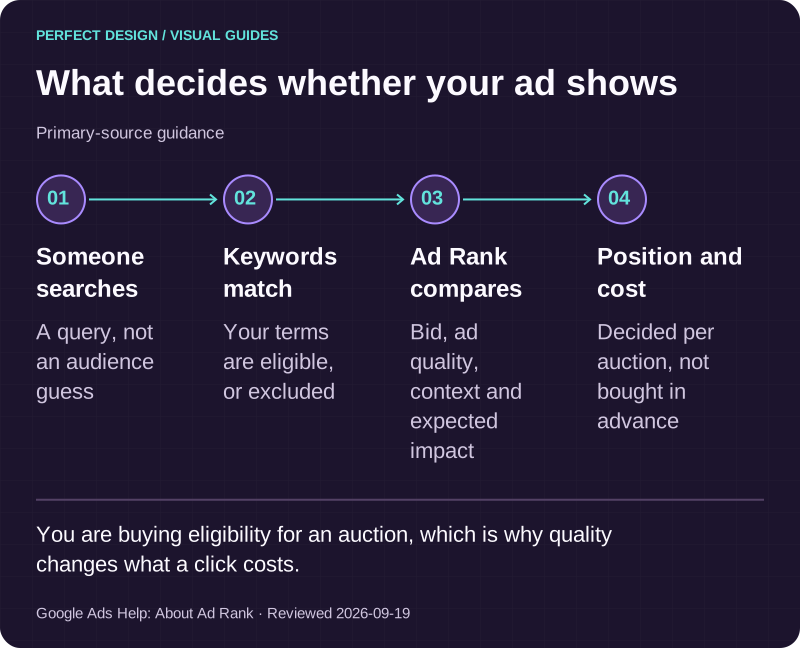
Position is not simply bought. Google describes Ad Rank as a set of values that decides whether your ad can show and, if so, where. Its inputs include your bid, the quality of your ads and landing page, minimum thresholds, the competition, the context of the search and the expected impact of your ad assets. A bigger bid does not guarantee a better position; work on the advert and the page it leads to sits in the same calculation as the money.

What decides whether your ad shows
Primary-source guidance. You are buying eligibility for an auction, which is why quality changes what a click costs.
Source: Google Ads Help: About Ad Rank. Reviewed .
Read the graphic as text
- Someone searches. A query, not an audience guess
- Keywords match. Your terms are eligible, or excluded
- Ad Rank compares. Bid, ad quality, context and expected impact
- Position and cost. Decided per auction, not bought in advance
Choosing the right campaign types
Search — text ads answering a query somebody typed — is the campaign type most Malaysian businesses start with, but it is not the whole product. Google organises advertising into campaign types and gives each one a job, and the one that fits depends on whether demand already exists, whether you have a product feed, and whether you are trying to be found or trying to be remembered.
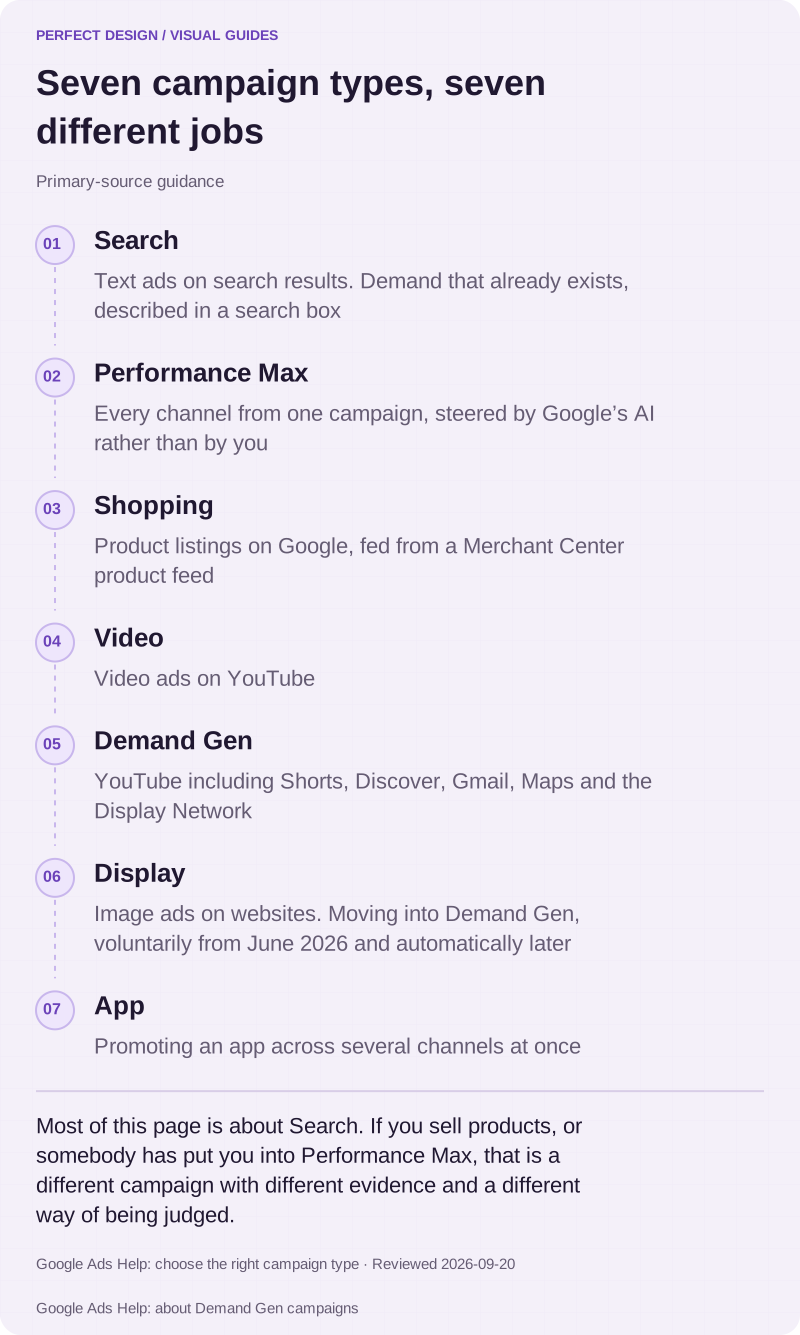
Two of these are worth knowing about before somebody sells you one. Performance Max puts a single campaign across every Google surface and hands the targeting to Google's AI, which means less steering and a harder time telling which surface actually produced a result. Display is being folded into Demand Gen: Google opened voluntary migration in June 2026 and has said new campaigns will eventually only be creatable in Demand Gen, with remaining eligible campaigns migrated automatically. An account nobody is actively managing will have that change made for it.
| Campaign type | What Google says it does | When it is the right one |
|---|---|---|
| Search | Text ads on search results, reaching people while they are searching on Google | Demand already exists and people are describing it in words |
| Shopping | Product listings on search results and the Shopping tab, for a retailer selling inventory | You sell products and can maintain a product feed |
| Performance Max | One goal-based campaign reaching all Google Ads inventory at once | You want coverage everywhere and accept far less steering |
| Video | Video ads on YouTube and other websites | The thing has to be shown or explained, not listed |
| Demand Gen | Engagement and action across YouTube including Shorts, Discover, Gmail, Maps and the Display Network | Creating interest before anyone searches |
| Display | Visual ads across millions of websites, apps and Google properties | Being remembered, and being migrated into Demand Gen |
| App | Finding new app users and increasing sales inside an app | The product is an app, not a website |
Most Malaysian businesses should settle Search before anything else, because it is the only one where the person has already told you what they want. Google Search Ads covers that campaign type properly. If you are weighing the others, or being sold one, How Google Ads works explains the machinery underneath all of them — the auction, budgets, conversion counting and policy — without a sales pitch attached.

Seven campaign types, seven different jobs
Primary-source guidance. Most of this page is about Search. If you sell products, or somebody has put you into Performance Max, that is a different campaign with different evidence and a different way of being judged.
Source: Google Ads Help: choose the right campaign type. Reviewed .
Also: Google Ads Help: about Demand Gen campaigns.
Read the graphic as text
- Search. Text ads on search results. Demand that already exists, described in a search box
- Performance Max. Every channel from one campaign, steered by Google’s AI rather than by you
- Shopping. Product listings on Google, fed from a Merchant Center product feed
- Video. Video ads on YouTube
- Demand Gen. YouTube including Shorts, Discover, Gmail, Maps and the Display Network
- Display. Image ads on websites. Moving into Demand Gen, voluntarily from June 2026 and automatically later
- App. Promoting an app across several channels at once
Where most Google Ads budgets are wasted
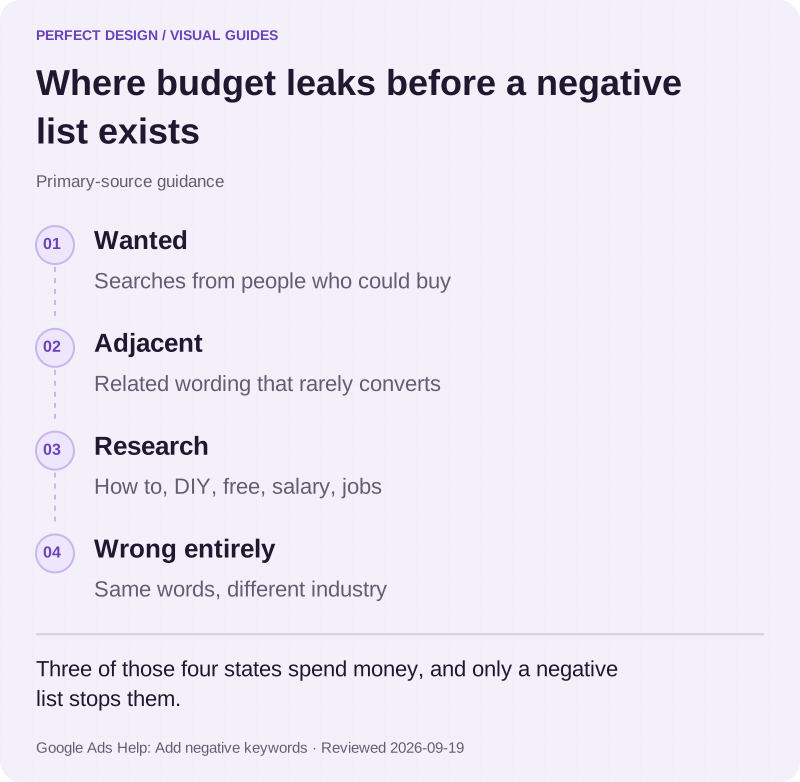
Most accounts we are asked to look at have the same shape: keywords on the broadest setting, no structure underneath and money going to searches nobody would have chosen. Three settings decide most of that waste. Match types decide how loosely a keyword is interpreted. The search terms report shows the searches that actually triggered your adverts. Negative keywords exclude the ones that only cost money, and Google documents that they do not stretch to plurals or misspellings, so each variation is added on its own.
For a Malaysian advertiser the first exclusions are usually the same: the word free, job and salary searches, do-it-yourself searches, neighbouring services you do not sell and competitor names you do not mean to bid on. The full detail on match types, the search terms report and exclusions lives on Google Search Ads, the campaign type they apply to.

Where budget leaks before a negative list exists
Primary-source guidance. Three of those four states spend money, and only a negative list stops them.
Source: Google Ads Help: Add negative keywords. Reviewed .
Read the graphic as text
- Wanted. Searches from people who could buy
- Adjacent. Related wording that rarely converts
- Research. How to, DIY, free, salary, jobs
- Wrong entirely. Same words, different industry
Quality Score is a diagnosis, not a price
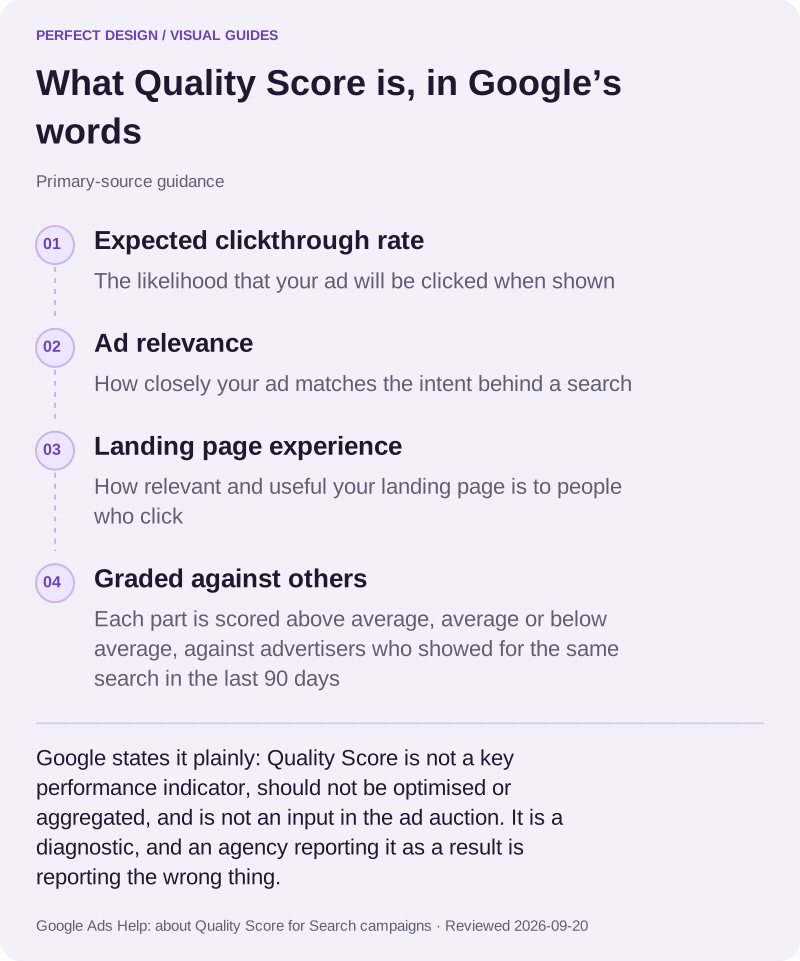
Quality Score is often discussed as a magic number. Google is plainer: it calls it a diagnostic tool that shows how your ad quality compares with other advertisers, on a scale of 1 to 10 for each keyword, and states that it is not an input in the ad auction. It is still worth reading because of its three parts — expected clickthrough rate, ad relevance and landing page experience — which map onto the three things you control: the searches you appear on, what the advert says and where it leads. A weak part tells you where to look, not what the fix is.

What Quality Score is, in Google’s words
Primary-source guidance. Google states it plainly: Quality Score is not a key performance indicator, should not be optimised or aggregated, and is not an input in the ad auction. It is a diagnostic, and an agency reporting it as a result is reporting the wrong thing.
Source: Google Ads Help: about Quality Score for Search campaigns. Reviewed .
Read the graphic as text
- Expected clickthrough rate. The likelihood that your ad will be clicked when shown
- Ad relevance. How closely your ad matches the intent behind a search
- Landing page experience. How relevant and useful your landing page is to people who click
- Graded against others. Each part is scored above average, average or below average, against advertisers who showed for the same search in the last 90 days
The page the click lands on is part of the campaign
Paid search fails at the destination more often than it fails in the account. Someone searches for one specific thing, an advert promises that thing, and the click lands on a homepage built to serve eleven audiences at once. The visitor now has to find their way back to what they were promised, and most will not.
The working rule is that the words in the advert should be recognisable in the first screen of the destination, which usually means a campaign page rather than a general section of the website. Landing page design covers how those are scoped, and where the wider site is the weak point, corporate website design is the other conversation. Either way the destination is website work with its own owner. Agree who makes changes to it before launch, or the campaign will eventually need an edit nobody is responsible for.

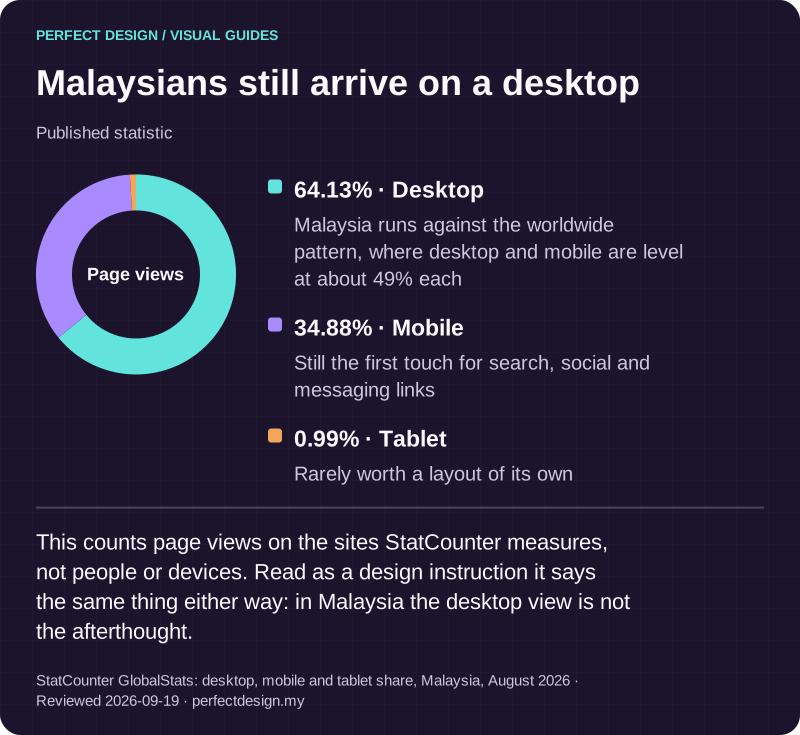
Malaysians still arrive on a desktop
Published statistic. This counts page views on the sites StatCounter measures, not people or devices. Read as a design instruction it says the same thing either way: in Malaysia the desktop view is not the afterthought.
Source: StatCounter GlobalStats: desktop, mobile and tablet share, Malaysia, August 2026. Reviewed .
Read the graphic as text
Page views
- Desktop: 64.13%. Malaysia runs against the worldwide pattern, where desktop and mobile are level at about 49% each
- Mobile: 34.88%. Still the first touch for search, social and messaging links
- Tablet: 0.99%. Rarely worth a layout of its own
Conversion tracking goes in before the spend, not after
This step gets deferred and should not be. Google's documentation is explicit that you choose what you identify as valuable, such as a purchase, a sign-up or a phone call, and that a conversion action is a specific customer activity valuable to your business, measured so the measurement can refine the campaign. Nothing decides that for you, and where nobody does, the account optimises toward clicks, which is the one thing you can buy without selling anything.
Tracking then has to be checked rather than assumed. Google notes that an unverified or inactive status is normal for a new tag and that it becomes active only once Google Ads records a first conversion or a successful test event, so putting a real submission through the real form is part of setup. Google also requires advertisers to give people clear information about the data collected on their sites and to obtain consent where law or policy requires it, which is built into the website rather than switched on in the account.
When we would tell you not to run Google Ads
Search advertising only reaches demand that exists as searches. If nobody is searching for what you sell, because the category is new or the decision starts in a social feed, the budget belongs on a channel built for interruption. We manage Meta Ads across Facebook and Instagram and TikTok Ads as well as Google Ads, so the recommendation does not depend on which platform we happen to run.
Two other situations are worth naming. If enquiries already sit unanswered for days, more of them will not help, and fixing the follow-up is the cheaper project. And where interest in your category is steady rather than seasonal, paid clicks stop the moment the budget does, while SEO and, for a storefront, local SEO keep arriving. The two are not rivals: paid search shows quickly which searches turn into enquiries, and our search visibility guides set out what search reports can and cannot prove.
What to bring to the first conversation
The offer and who is eligible for it, the page you want people to land on, who approves claims in an advert, who owns changes to the website and what counts as a genuine enquiry. That is enough for us to say what is included, what has to be built first, and whether we would recommend starting at all.