

On this page11 sections
- 01The short answer
- 02What each one costs over three years
- 03Worked example: a small store
- 04Worked example: a growing store
- 05Efficiency: speed and the work behind each order
- 06Customisation: what you can change
- 07What changes for a Malaysian store
- 08Who owns what, and how you leave
- 09When Shopify or WooCommerce is the better choice
- 10When a custom store wins
- 11What a custom store costs with us
The short answer
All three can run a good store. They differ in who pays for what each month, who keeps the store running and how far you can change it.
| Shopify | WooCommerce | Custom store | |
|---|---|---|---|
| What it is | A hosted platform you subscribe to | A free plugin that runs on your own WordPress hosting | A store built for your business, which you own |
| Monthly cost | From US$25 a month (US$19 billed yearly), plus apps | Hosting, plus yearly renewals for paid extensions | A care plan, from RM 250 a month with us, hosting included |
| Fee on each sale | 2%, 1% or 0.6% by plan, on top of your gateway’s fee | None | None |
| Extra features | Monthly apps | Paid extensions, renewed yearly | Built into the store |
| Upkeep | Shopify runs the platform; you manage the theme and apps | You or your developer: updates, security and backups | Your developer, under the care plan |
| Checkout changes | Logo, colours and fonts; more on Shopify Plus | Anything, through plugins or code | Anything |
| Leaving later | Products, customers and orders export as CSV; the theme and apps stay | Your files and database | Your code, data and accounts |
| Usually best for | Small catalogues and simple selling | Stores already on WordPress, with someone to maintain them | Growing stores, and anything beyond simple selling |
What each one costs over three years
The launch price is the smallest part of the bill. Compare what you pay over the years you run the store: the build, the monthly charges and the fees taken from every order. Payment gateway fees are left out of the totals, because the same gateway costs the same on all three. The one exception is noted under Shopify.
Shopify: a plan, apps and a fee on every order
Shopify shows Malaysian stores local prices, billed in US dollars: Basic at US$25 a month or US$19 billed yearly, Grow at US$65 or US$49, and Advanced at US$399 or US$299. Basic includes no staff accounts, so a store with staff needs Grow, which has five, or Advanced, with fifteen. Shopify Plus starts at US$2,300 a month on a three-year term. Shopify also charges Malaysian stores SST on its fees and does not accept an SST number for exemption, and the service tax rate on digital services is 8%.
The bigger cost is the fee on each order. Shopify Payments, the option that avoids it, is not available in Malaysia, so a Malaysian store takes FPX, DuitNow and card payments through a third-party gateway such as HitPay, Curlec or Billplz. Shopify then adds its own fee to every online order: 2% on Basic, 1% on Grow and 0.6% on Advanced. It comes on top of the gateway’s fee and is not returned when you refund an order. Only point-of-sale orders and manual payments, such as cash on delivery or a bank deposit, are exempt. Some gateways charge extra on Shopify too: HitPay lists an additional 0.5% through its Shopify app. A RM 100 order paid by FPX through HitPay on the Basic plan costs RM 2.20 in HitPay fees, RM 0.50 for its Shopify app and RM 2.00 to Shopify.
Features most stores add later are apps with their own monthly charge, also billed in US dollars. From the Shopify App Store: Smile loyalty rewards is free up to 200 orders a month, then US$15, US$79 and US$199 as orders grow, and letting customers redeem points at checkout needs Shopify Plus. Judge.me reviews costs US$15 a month on its paid plan. Booking apps such as Sesami (US$19 to US$299 a month) and BookThatApp (US$25 to US$110) charge by plan and booking volume.
WooCommerce: free software, with hosting and renewals
WooCommerce itself is free and open source. You pay for the hosting it runs on and for the extensions that add features. WordPress hosting in Malaysia starts at about RM 20 a month on a three-year term: ServerFreak’s WP Ultimate plan, which it describes as ideal for WooCommerce, is RM 1,540 for three years, and Exabytes’ AI Ecommerce plan is RM 92.99 a month on a 36-month term. Managed hosts such as Kinsta start at US$35 a month.
Extensions from the WooCommerce Marketplace are billed yearly: WooCommerce Subscriptions US$279, Bookings US$249, Memberships US$199, Points and Rewards US$179, Product Bundles US$79 and Product Add-Ons US$79. If a renewal lapses, the extension keeps working but stops receiving updates and security patches. Someone also has to keep WordPress, WooCommerce, the theme and every plugin updated and backed up, which is either your time or a developer’s.
A custom store: a bigger build, then a fixed care fee
A custom store is built once for your business, so the larger cost comes first. Our published prices start at RM 5,999 for an ecommerce website and RM 12,000 for custom platforms, which include ecommerce platforms. Care for a store with a real backend starts from RM 250 a month and covers hosting, SSL, domain renewal and upkeep. After that there is no platform fee on your sales and nothing extra to subscribe to: subscriptions, loyalty or bookings are part of the store. Your quote depends on what the store has to do.
Worked example: a small store
This is an illustrative calculation, not a quote. The store sells RM 8,000 a month from a simple catalogue, is run by its owner and needs no paid add-ons. Shopify is on the Basic plan, billed yearly. WooCommerce and the custom store are on a care plan from RM 250 a month, which includes hosting. The builds use our published starting prices: RM 5,999 for the Shopify and WooCommerce stores and RM 12,000 for the custom store. US dollars are converted at RM 4.09, Bank Negara Malaysia’s middle rate on 1 October 2026, and SST is left out.
| Shopify Basic | WooCommerce | Custom store | |
|---|---|---|---|
| Build | RM 5,999 | RM 5,999 | RM 12,000 |
| Plan or hosting | RM 2,798 | In the care plan | In the care plan |
| Shopify’s fee on sales (2%) | RM 5,760 | None | None |
| Paid add-ons | None | None | None |
| Care and upkeep | Not needed for hosting | RM 9,000 | RM 9,000 |
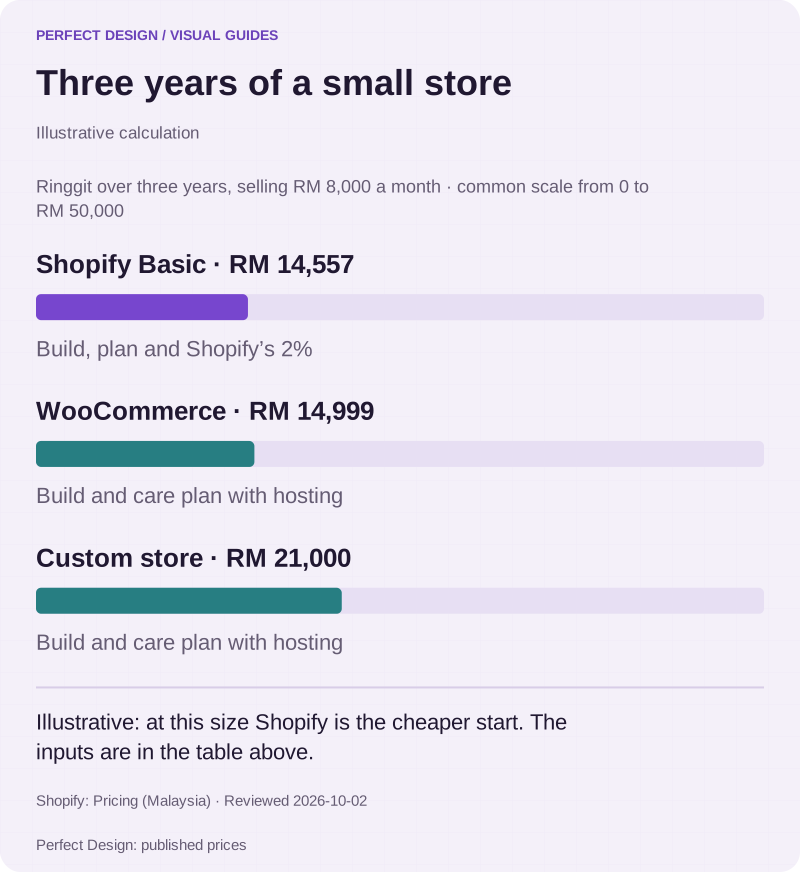
| Three years | RM 14,557 | RM 14,999 | RM 21,000 |
At this size Shopify is the cheaper start, and WooCommerce costs less still if you look after it yourself: ServerFreak’s WP Ultimate hosting is RM 1,540 for three years. For a small store with ordinary needs, that is the honest answer.

Three years of a small store
Illustrative calculation. Illustrative: at this size Shopify is the cheaper start. The inputs are in the table above.
Basis: Shopify: Pricing (Malaysia). Reviewed .
Also: Perfect Design: published prices.
Read the graphic as text
- Shopify Basic: RM 14,557. Build, plan and Shopify’s 2%
- WooCommerce: RM 14,999. Build and care plan with hosting
- Custom store: RM 21,000. Build and care plan with hosting
Chart scale: Ringgit over three years, selling RM 8,000 a month · common scale from 0 to RM 50,000.
Worked example: a growing store
The same assumptions, for a store selling RM 60,000 a month, about 600 orders, with subscriptions, a points programme and product reviews. Shopify is on the Grow plan billed yearly, because the store has staff, with the Smile loyalty app at US$79 a month (up to 1,000 orders), Judge.me reviews at US$15 a month and Shopify’s free Subscriptions app, which needs PayPal or another gateway Shopify supports for subscriptions (see below). WooCommerce uses the Subscriptions and Points and Rewards extensions, and product reviews are built into WooCommerce. The custom store has all three built in.
| Shopify Grow | WooCommerce | Custom store | |
|---|---|---|---|
| Build | RM 5,999 | RM 5,999 | RM 12,000 |
| Plan or hosting | RM 7,215 | In the care plan | In the care plan |
| Shopify’s fee on sales (1%) | RM 21,600 | None | None |
| Paid add-ons | RM 13,841 | RM 5,620 | Built in |
| Care and upkeep | Not needed for hosting | RM 9,000 | RM 9,000 |
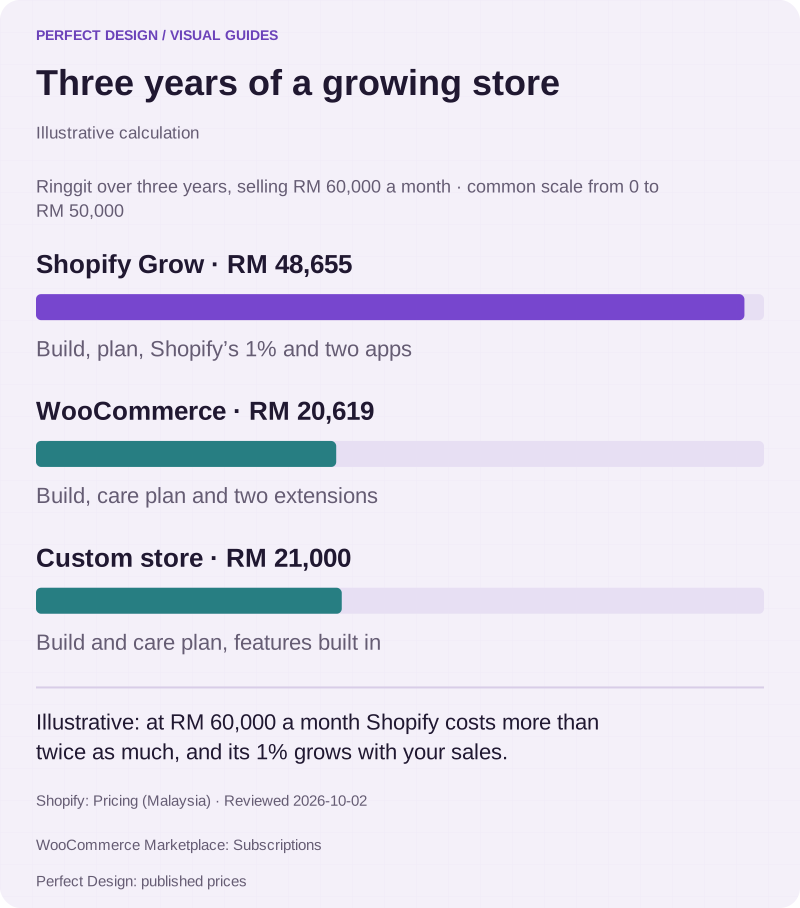
| Three years | RM 48,655 | RM 20,619 | RM 21,000 |
Now Shopify costs more than twice as much as either of the others, and the gap grows with your sales: its 1% alone is RM 7,200 a year at this volume. WooCommerce and the custom store cost about the same over three years. Over five years the custom store pulls ahead, at RM 27,000 against RM 30,365 for WooCommerce and RM 77,091 for Shopify, because its build is paid once while renewals and fees keep coming. Between WooCommerce and custom, the decision then rests on speed, upkeep and fit, covered below.
Where the lines cross
With no paid apps, a custom store costs the same as Shopify over three years once sales reach about RM 17,000 a month on the Basic plan, or about RM 21,600 on Grow. Above that, Shopify costs more every month. Every paid app lowers that point, which is why stores that sell subscriptions, run a loyalty programme or take bookings tend to reach it early. Run the sums with your own sales, plan and apps before you decide.

Three years of a growing store
Illustrative calculation. Illustrative: at RM 60,000 a month Shopify costs more than twice as much, and its 1% grows with your sales.
Basis: Shopify: Pricing (Malaysia). Reviewed .
Also: WooCommerce Marketplace: Subscriptions.
Also: Perfect Design: published prices.
Read the graphic as text
- Shopify Grow: RM 48,655. Build, plan, Shopify’s 1% and two apps
- WooCommerce: RM 20,619. Build, care plan and two extensions
- Custom store: RM 21,000. Build and care plan, features built in
Chart scale: Ringgit over three years, selling RM 60,000 a month · common scale from 0 to RM 50,000.
Efficiency: speed and the work behind each order
How fast the store loads
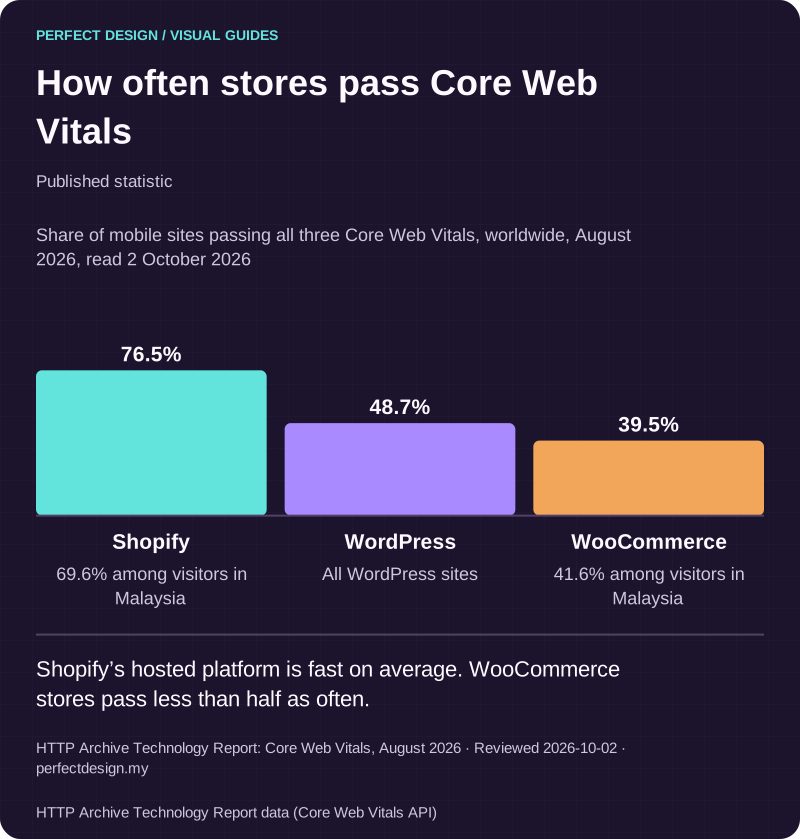
Google measures what real visitors experience with three Core Web Vitals, and HTTP Archive publishes how many sites on each platform pass all three. In August 2026, on mobile, 76.5% of Shopify stores passed, against 48.7% of WordPress sites and 39.5% of WooCommerce stores. Among Chrome users in Malaysia, the figures were 69.6% for Shopify and 41.6% for WooCommerce. Shopify’s hosted platform is fast on average. WooCommerce stores pass less than half as often, because every plugin and theme adds weight that someone has to manage.
A custom store is not automatically fast either. It loads only the code your store needs and carries no theme or app scripts, so its speed is yours to control rather than a platform’s. How the three measures work, and how to read them, is in our Core Web Vitals guide.
How much work each order takes
A store is more than a checkout. Someone packs the order, answers the customer, renews the subscription, credits the points and books the appointment. On Shopify and WooCommerce, each of those jobs often lives in its own app or plugin with its own records, so staff switch between screens and the same customer exists in several places. A custom store keeps one record for each customer and each order, and every screen works from it.
Our concept builds show what that looks like, with sample data:
- Sundial, a café group: table ordering, points and vouchers, the kitchen display and head-office campaigns run on one set of records. A paid order adds the points, and switching an item off hides it on every menu.
- Underline, a tuition centre: downloads, monthly plans, classes and the parent portal share one account per family, so a purchase reaches the student and the parent at once.
- Rentak, a fitness studio: bookings, memberships, the waitlist, coach cover and the member community all work from the same bookings.
- Teduh, an aircond company: a WhatsApp request becomes a quote, the quote becomes a job and the job becomes an invoice, without anyone retyping it.

How often stores pass Core Web Vitals
Published statistic. Shopify’s hosted platform is fast on average. WooCommerce stores pass less than half as often.
Source: HTTP Archive Technology Report: Core Web Vitals, August 2026. Reviewed .
Also: HTTP Archive Technology Report data (Core Web Vitals API).
Read the graphic as text
- Shopify: 76.5%. 69.6% among visitors in Malaysia
- WordPress: 48.7%. All WordPress sites
- WooCommerce: 39.5%. 41.6% among visitors in Malaysia
Chart scale: Share of mobile sites passing all three Core Web Vitals, worldwide, August 2026, read 2 October 2026.
Customisation: what you can change
Shopify
Shopify’s checkout editor lets every plan change the logo, colours, fonts and background. Apps can add to the thank-you and order status pages on any plan, but apps in the information, shipping and payment steps need Shopify Plus, and so do custom apps that use Shopify Functions to change how the checkout behaves. Each product can have up to three options and 2,048 variants, and Shopify notes that some themes do not support more than 100 variants.
Subscriptions are the sharpest limit for a Malaysian store. Shopify’s own Subscriptions app works only with Shopify Payments, PayPal Express, Authorize.net, Adyen or Stripe, which Shopify says is available only to select merchants, and it warns that local and non-card payment methods might not be available for subscriptions. Third-party subscription apps have the same list. With Shopify Payments unavailable here, a subscriber cannot simply pay by FPX or DuitNow.
Selling to businesses is possible on every plan, with up to three active B2B catalogues below Plus. Deposits and partial payments on business orders need Plus.
WooCommerce
WooCommerce gives you the code, so almost anything can be changed through plugins or custom work. The cost is upkeep and risk. Patchstack counted 11,334 new vulnerabilities in the WordPress ecosystem in 2025, 42% more than in 2024. 91% were in plugins, and 46% had no fix from the developer when they were disclosed. Every plugin you add is software someone has to keep current.
Subscriptions renew automatically only through gateways whose extension supports it, such as Stripe or PayPal. With other gateways, each renewal becomes an order the customer has to pay by hand.
A custom store
A custom store follows your rules instead of bending them around a template, and the checkout follows how your customers actually buy, so the steps that lose them can be removed. Each of our concept builds runs rules a template would not have:
- Teduh: staff can discount up to 10%, the owner up to 20%, and nothing higher can be sent.
- Rentak: cancelling is free until 12 hours before class, and the first late cancel in 30 days is waived.
- Sundial: points are added only when an order is paid, and vouchers check expiry, minimum spend, channel and item.
- Underline: a 10% sibling discount, and a Family plan that covers up to three children.
Recurring payments can use Malaysian methods too. Curlec, for example, bills subscriptions by card or by e-Mandate, where the customer authorises direct debits from their bank account.
What changes for a Malaysian store
- Payments: FPX, DuitNow QR and e-wallets such as Touch ’n Go and GrabPay come through local gateways on all three routes, and on Shopify each order also carries Shopify’s fee. What four Malaysian gateways publish is tabulated on our ecommerce page.
- Tax on the platform: Shopify adds SST to its fees for stores in Malaysia.
- Currency: Shopify plans, Shopify apps and WooCommerce extensions are billed in US dollars, so their cost in ringgit moves with the exchange rate.
- E-invoicing: LHDN’s e-invoice applies in phases by turnover, and from 1 September 2026 businesses with annual turnover under RM 3 million are exempt. A custom store can send e-invoices straight to LHDN’s MyInvois system, which provides APIs for business systems.

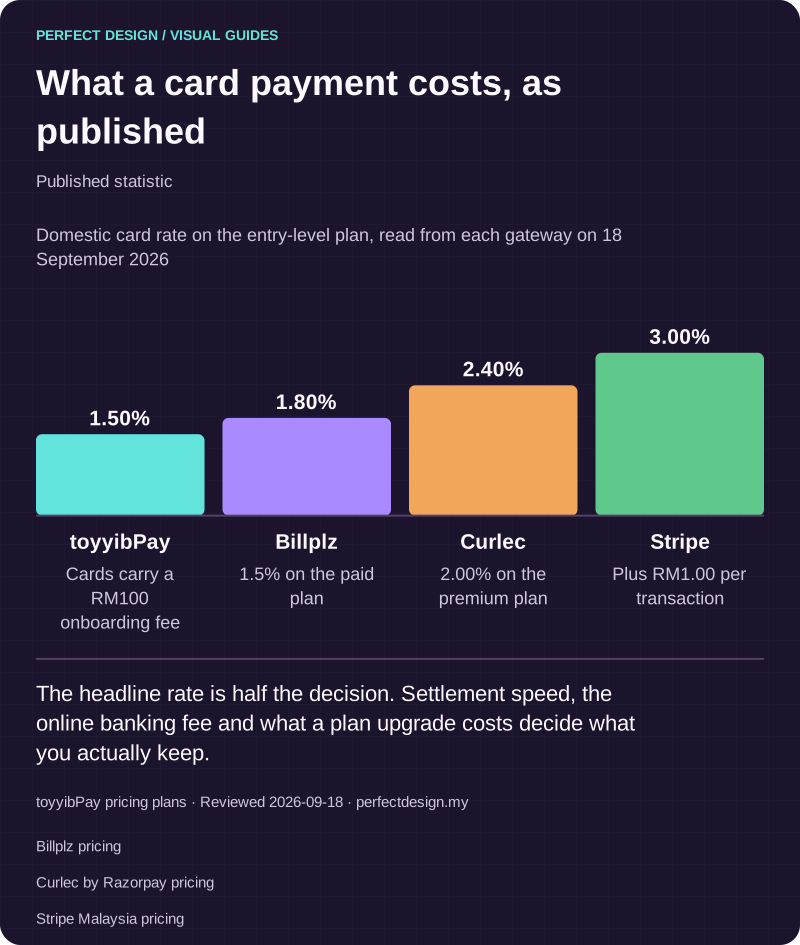
What a card payment costs, as published
Published statistic. The headline rate is half the decision. Settlement speed, the online banking fee and what a plan upgrade costs decide what you actually keep.
Source: toyyibPay pricing plans. Reviewed .
Also: Billplz pricing.
Also: Curlec by Razorpay pricing.
Also: Stripe Malaysia pricing.
Read the graphic as text
- toyyibPay: 1.50%. Cards carry a RM100 onboarding fee
- Billplz: 1.80%. 1.5% on the paid plan
- Curlec: 2.40%. 2.00% on the premium plan
- Stripe: 3.00%. Plus RM1.00 per transaction
Chart scale: Domestic card rate on the entry-level plan, read from each gateway on 18 September 2026.
Who owns what, and how you leave
On Shopify you can export products, customers, orders, gift card codes, discount codes and financial data as CSV files, and download your theme. Product images are not in the product file, customer passwords cannot be moved and themes are licensed to the one store they were bought for. When a store is closed, its apps are uninstalled.
WooCommerce runs on your own hosting, so the files and the database are yours to move. With a custom store from us, you own everything we build: the code, the content, the domain, the hosting account and every account opened for the project. There is no lock-in, and if you move to another provider we help with the handover.
When Shopify or WooCommerce is the better choice
Custom is not automatically right. A small catalogue with ordinary needs often launches faster and cheaper on Shopify or WooCommerce, and we will say so. That is usually the case when:
- your sales are below about RM 15,000 a month and you need no paid apps;
- you are testing whether a product sells at all;
- you sell a few dozen products, take card and FPX payments and ship with one courier;
- you already run WordPress and have someone who keeps it updated, which suits WooCommerce.
We build on both. See Shopify development and WooCommerce development.
When a custom store wins
- Your sales are high enough that Shopify’s fee costs more than a care plan: above roughly RM 17,000 a month on Basic or RM 21,600 on Grow, and sooner with paid apps.
- You sell more than products: subscriptions, memberships, bookings, courses or downloads.
- Your subscribers want to pay by FPX or direct debit, not only by card or PayPal.
- Your business has rules a template lacks, such as trade prices, approvals, deposits or credit terms.
- Several outlets, warehouses or sales channels must share one stock count.
- Your monthly app bill keeps growing.
- You pay for ads, so slow product pages cost you money on every click.
What a custom store costs with us
Our ecommerce websites start from RM 5,999 and custom platforms from RM 12,000, both published on our pricing page. Care for a store with a backend starts from RM 250 a month and covers hosting, SSL, domain renewal and upkeep. We build a free working prototype first, with no payment obligation, so you can click through your store before you commit. Tell us what you sell and we will work out the three-year numbers for your business.
Does Shopify charge transaction fees in Malaysia?
Yes, on every online order. Shopify Payments, which avoids the fee, is not available in Malaysia, so stores use a third-party gateway and Shopify charges 2% on Basic, 1% on Grow, 0.6% on Advanced and 0.2% on Plus, on top of the gateway’s own fee.
Is Shopify cheaper than a custom online store?
For a small store, usually yes. In our worked example, a store selling RM 8,000 a month spends about RM 14,600 over three years on Shopify against RM 21,000 for a custom store. At RM 60,000 a month with subscriptions, loyalty and reviews, it is about RM 48,700 on Shopify against RM 21,000.
Can WooCommerce take FPX and DuitNow?
Yes. Malaysian gateways including Billplz, toyyibPay and HitPay publish WooCommerce plugins on WordPress.org. Check that a plugin is kept up to date before you rely on it.
Which one is fastest?
On average, Shopify: in August 2026, 76.5% of Shopify stores passed Google’s Core Web Vitals on mobile, against 39.5% of WooCommerce stores. A custom store can match that when speed is designed in, because it carries no theme or app code it does not need.
Can I move from Shopify to a custom store later?
Yes. Products, customers and orders export from Shopify as CSV files. Product images and customer passwords do not come with them, so plan the image move and ask customers to set a new password on the new store.
Do you still build Shopify and WooCommerce stores?
Yes. We build all three and recommend the one that fits your sales, your features and who will run the store. For a small, simple store, that is often Shopify.
Where to go next
- Ecommerce website development →
How we scope and build a store on any of the three routes, from RM 5,999.
- Shopify development →
When Shopify is the right call: themes, apps, checkout and fees.
- WooCommerce development →
Running WooCommerce well: hosting, plugins, updates and security.
- Subscription commerce →
Recurring billing, pauses and failed payments, built around Malaysian payment methods.
- Sundial concept build →
Ordering, loyalty and a kitchen display in one system, with sample data.
Rather have this handled?
Talk to us about e-commerce websites for your business, starting with the questions this guide helped you identify.
Sources and further reading
- Shopify: Pricing (Malaysia) — read 2 October 2026
- Shopify: Shopify Plus pricing — read 2 October 2026
- Shopify Help Center: Shopify Payments supported countries — read 2 October 2026
- Shopify Help Center: Third-party transaction fees — read 2 October 2026
- Shopify Help Center: Taxes on Shopify bills in India, Malaysia, Singapore and Thailand — read 2 October 2026
- Royal Malaysian Customs Department: Service tax FAQ — read 2 October 2026
- Shopify Help Center: Checkout customization by plan — read 2 October 2026
- Shopify Dev: Shopify Functions — read 2 October 2026
- Shopify Help Center: Adding variants — read 2 October 2026
- Shopify Help Center: Shopify Subscriptions app considerations — read 2 October 2026
- Shopify Help Center: B2B plan features — read 2 October 2026
- Shopify Help Center: Duplicating a store — read 2 October 2026
- Shopify Help Center: Deactivating your store — read 2 October 2026
- Shopify App Store: Smile loyalty and rewards — read 2 October 2026
- Shopify App Store: Judge.me product reviews — read 2 October 2026
- Shopify App Store: Sesami appointment booking — read 2 October 2026
- Shopify App Store: BookThatApp — read 2 October 2026
- HitPay: Malaysia pricing — read 2 October 2026
- WooCommerce: Pricing — read 2 October 2026
- WooCommerce Marketplace: WooCommerce Subscriptions — read 2 October 2026
- WooCommerce Marketplace: WooCommerce Bookings — read 2 October 2026
- WooCommerce Marketplace: Points and Rewards — read 2 October 2026
- WooCommerce docs: What WooCommerce.com subscriptions cover — read 2 October 2026
- WooCommerce docs: Subscriptions payment gateways — read 2 October 2026
- ServerFreak: WordPress hosting — read 2 October 2026
- Exabytes: WordPress hosting — read 2 October 2026
- Kinsta: Pricing — read 2 October 2026
- Patchstack: State of WordPress Security in 2026 — read 2 October 2026
- HTTP Archive: Technology Report, Core Web Vitals (August 2026) — read 2 October 2026
- Curlec: Subscription payments — read 2 October 2026
- LHDN: e-Invoice Guideline — read 2 October 2026
- LHDN: MyInvois SDK — read 2 October 2026
- Bank Negara Malaysia: Exchange rates — read 2 October 2026